


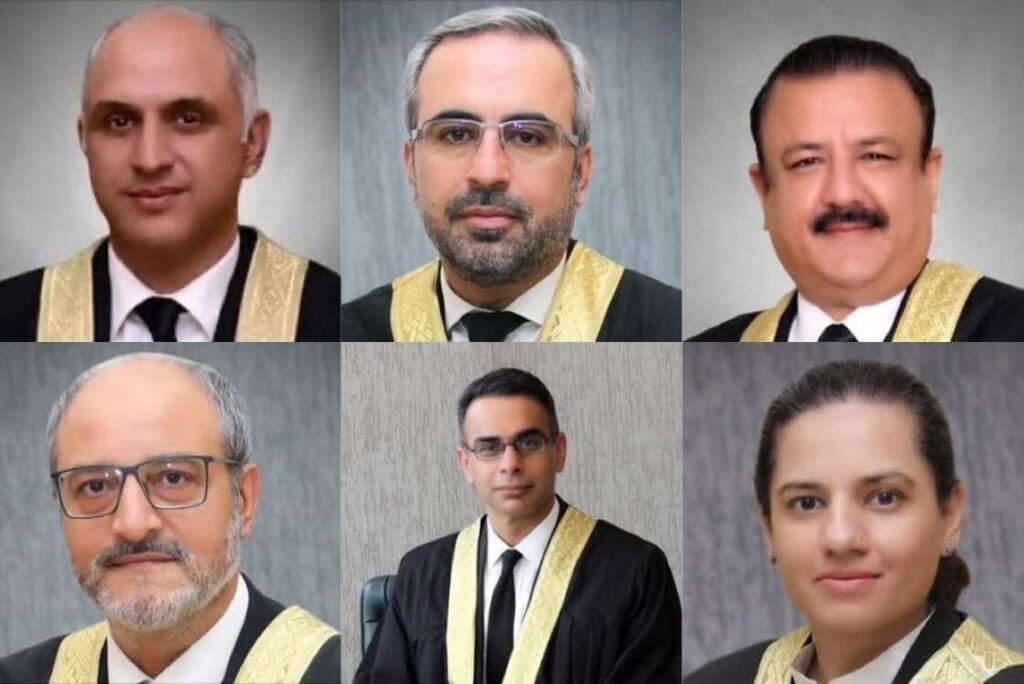
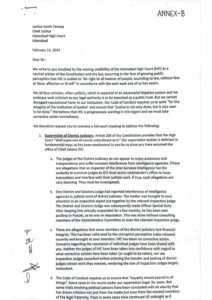
In an incriminating letter to the Supreme Judicial Council (SJC), six judges of the Islamabad High Court (IHC) have detailed the blatant interference of the country’s intelligence agencies in judicial affairs. This includes brazen attempts to pressure judges through the abduction and torture of their relatives, and secret illegal surveillance conducted inside their homes to influence decisions.
The letter to the SJC addressed the chairman of the SJC, Chief Justice Qazi Faez Isa, members of the SJC, Justice Mansoor Ali Shah and Justice Munib Akhtar, and Chief Justices of the Islamabad High Court and Peshawar High Court, also questioned if there exists a state policy to intimidate and coerce judges.
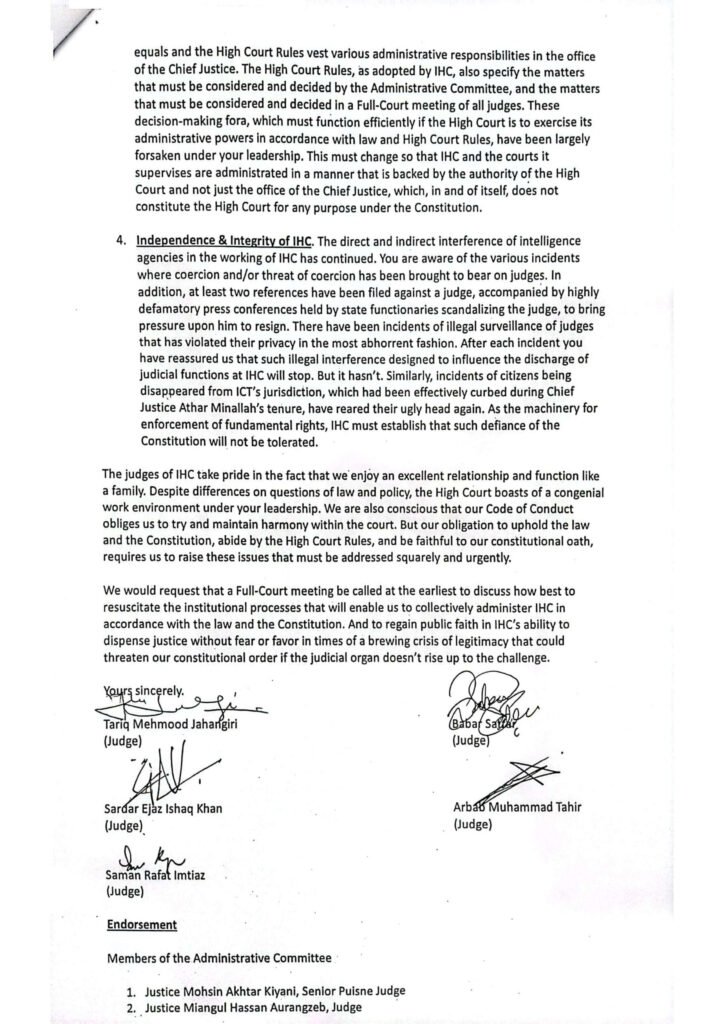
The letter has been signed by the Islamabad High Court Justices Mohsin Akhtar Kayani, Tariq Mehmood Jahangiri, Babar Sattar, Sardar Ejaz Ishaq Khan, Arbab Muhammad Tahir and Saman Rafat Imtiaz.
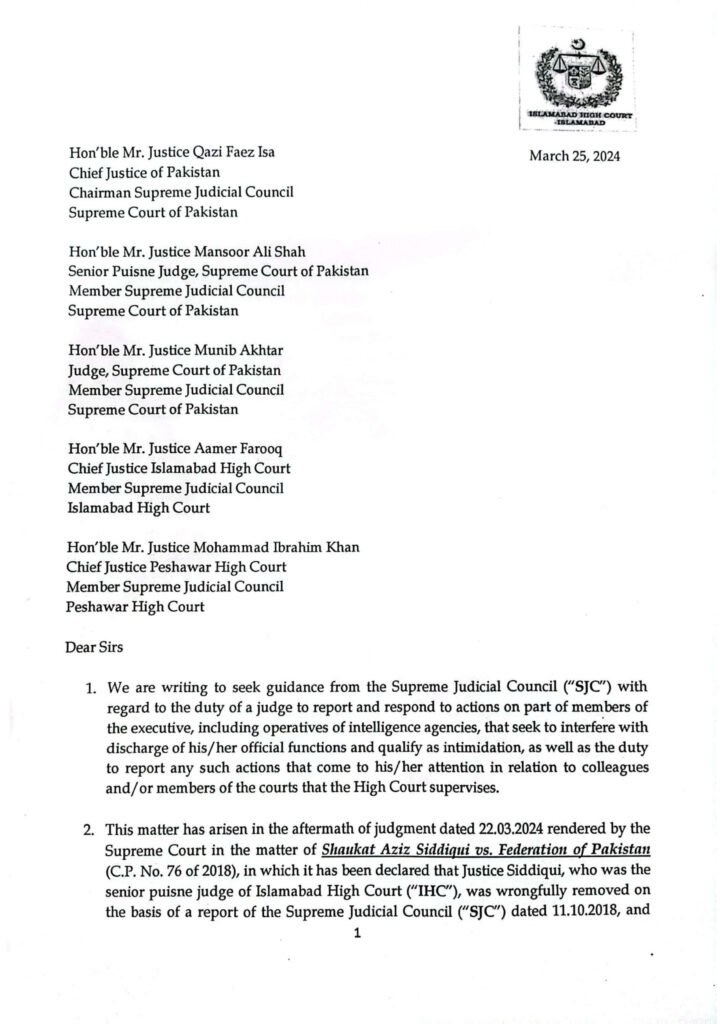
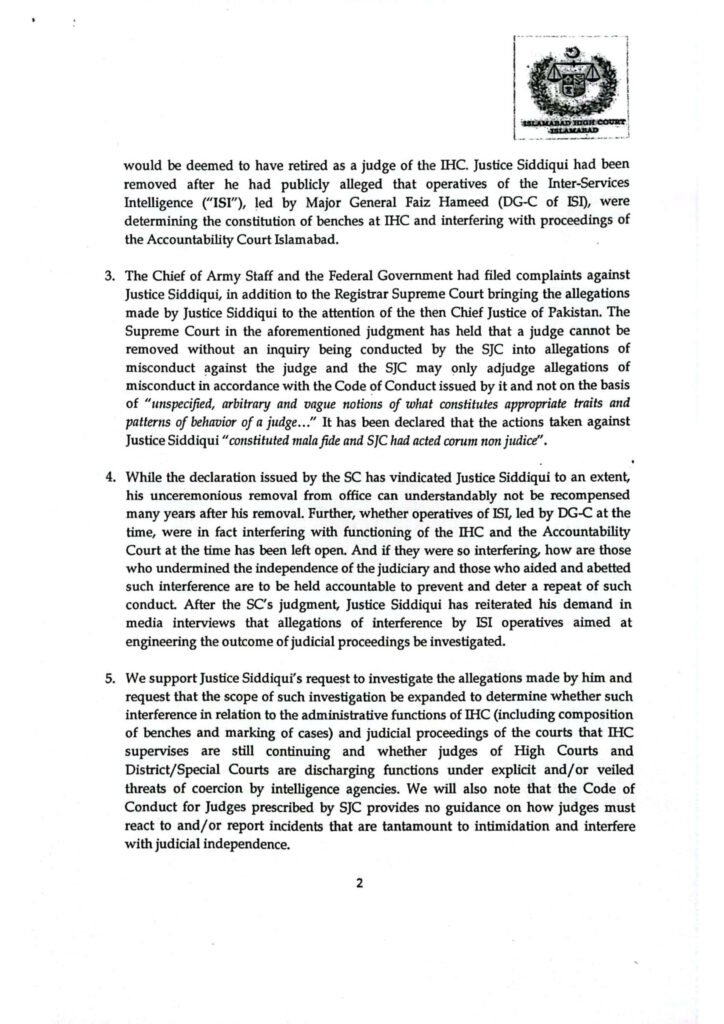
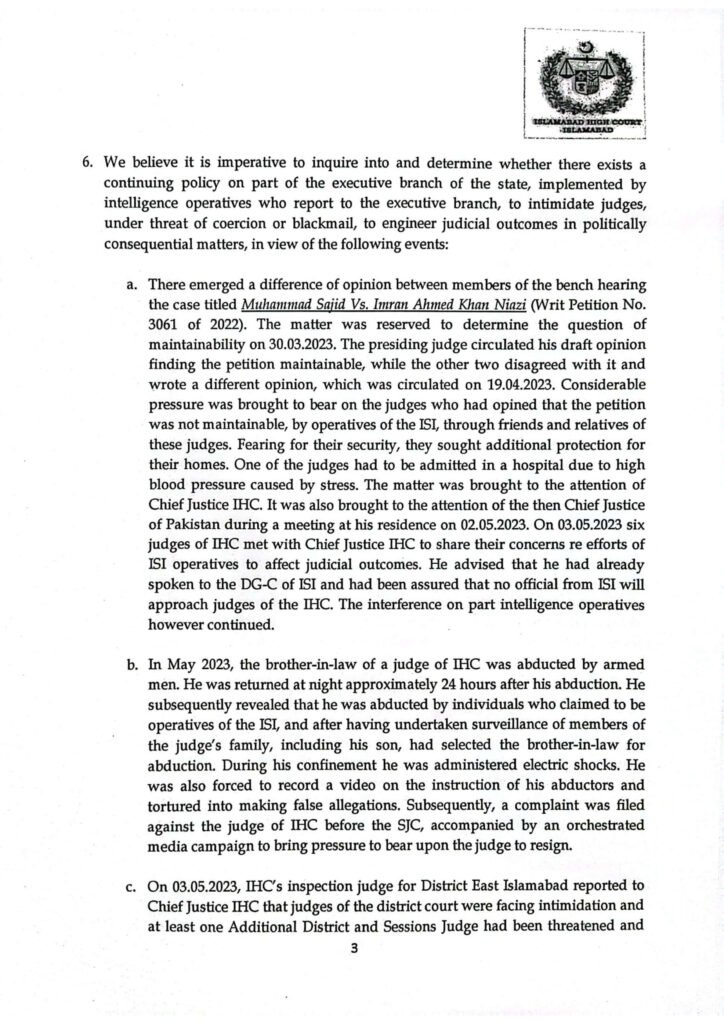
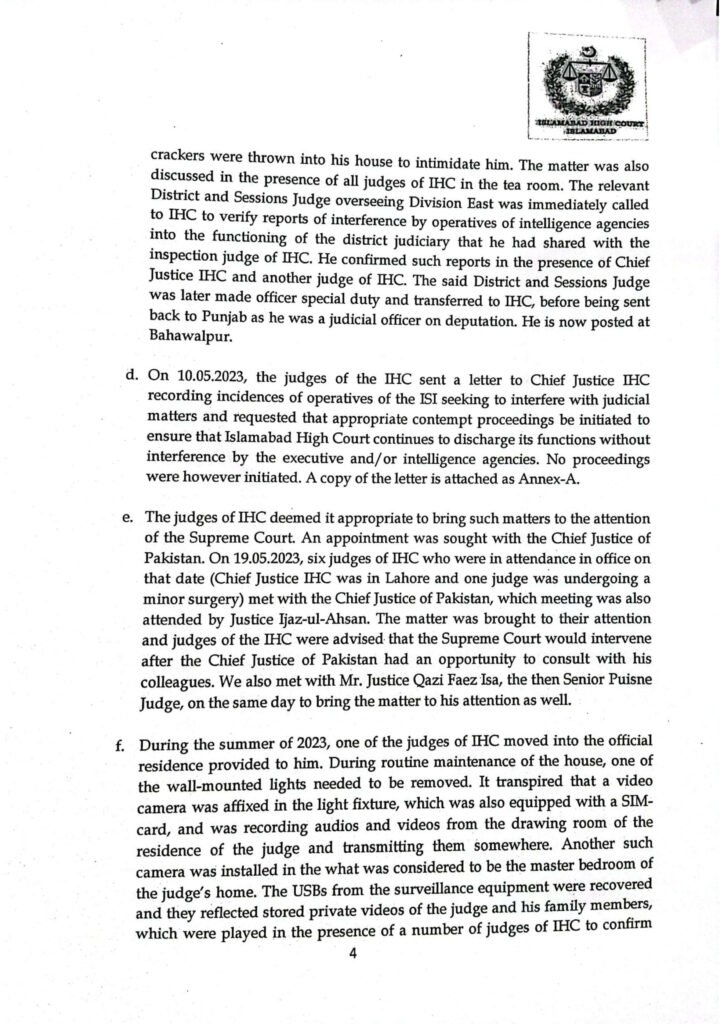
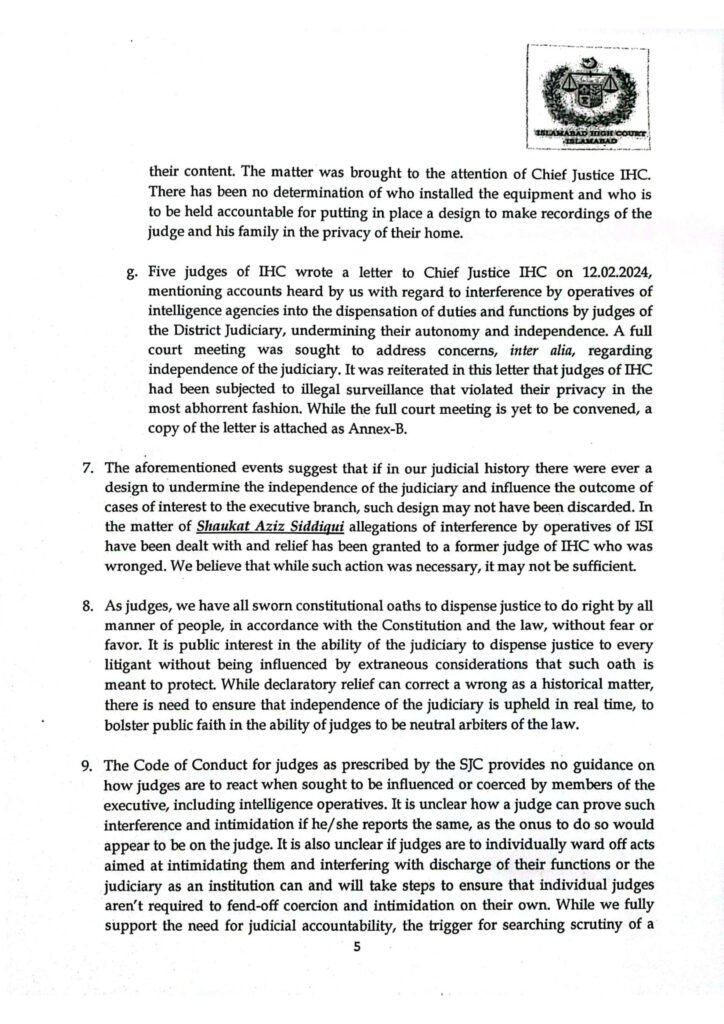
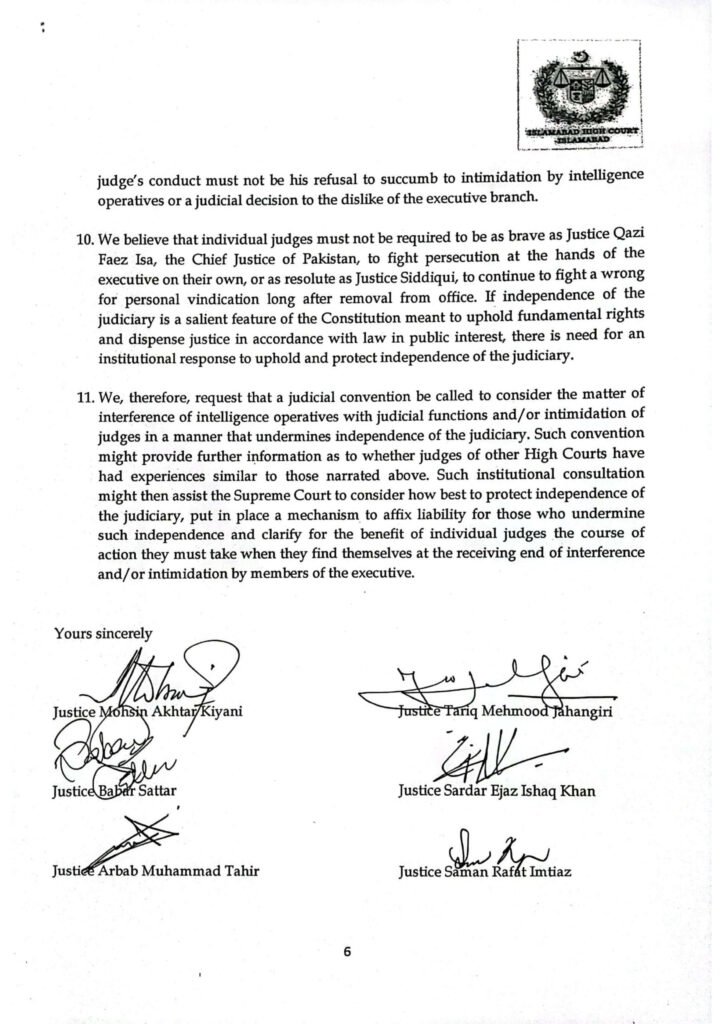
The letter to the SJC mentioned several instances of interference and intimidation by intelligence agency operatives “to influence the outcome of cases of interest:”
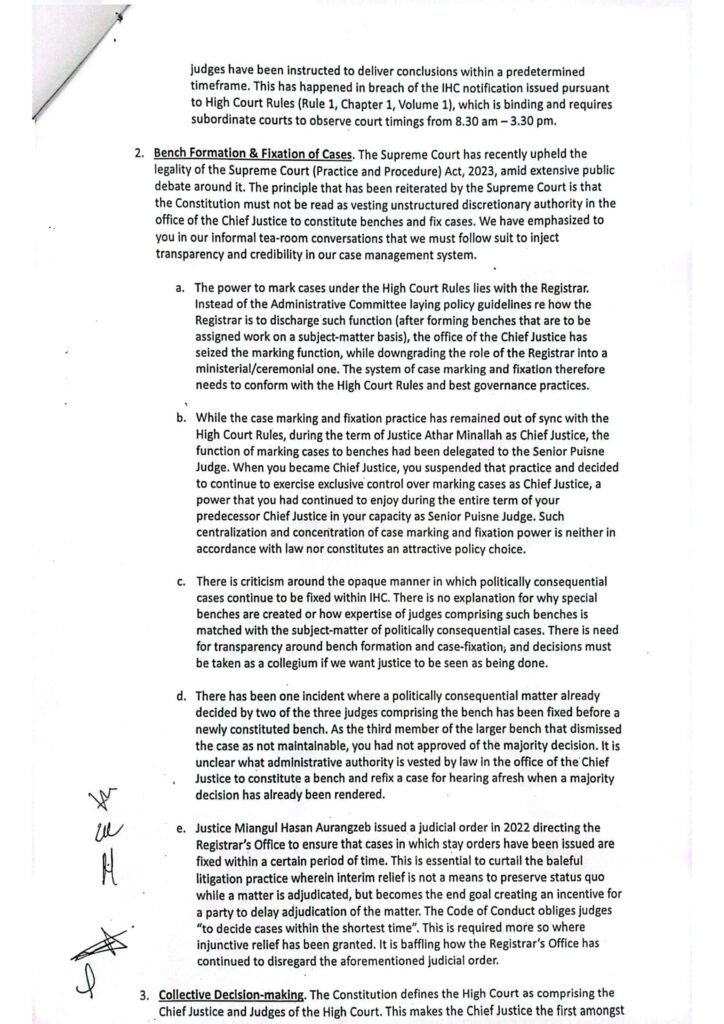
- In one instance, it referred to the Tyrian White case against PTI founder and former Prime Minister Imran Khan, pointing out that when two out of three judges in the bench opined that the case was not maintainable, they were pressured by “operatives of the ISI” through friends and relatives.
- According to the letter by the six judges, this matter was brought to the attention of the IHC Chief Justice, Aamer Farooq, and the then-CJP, Umar Ata Bandial. The former informed the judges that he had “spoken to the DG-C of ISI and had been assured that no official from ISI will approach the judges of the IHC”. However, the “interference on the part of intelligence operatives” continued even after IHC CJ’s assurance.
- The letter to the SJC also mentioned the abduction of an IHC judge’s brother-in-law by armed men who claimed to be ISI operatives. The victim was “administered electric shocks” and “forced to record a video,” making false allegations against the judge. “Subsequently, a complaint was filed against the judge of IHC before the SJC, accompanied by an orchestrated media campaign to bring pressure to bear upon the judge to resign.”
- The letter to the SJC also revealed that in May 2023, an IHC inspection judge reported to the chief justice that district court judges were being intimidated and crackers were thrown into the house of one additional district and session judge.
The judge was also called to the IHC to verify the claims, which he confirmed. However, instead of probing the allegations, the judge “was made officer on special duty and transferred to the IHC before being sent back to Punjab as he was a judicial officer on deputation.” - The letter by IHC judges also mentions an incident from 2023, when during routine maintenance, an IHC judge found that his official residence had been bugged with spy cameras in his drawing room and bedroom.
When data from surveillance equipment was recovered, it showed that “private videos of the judge and his family members” were stored. “The matter was brought to the attention of Chief Justice IHC. [However], there has been no determination of who installed the equipment and who is to be held accountable.” - Moreover, Justice Tariq Mehmood Jahangiri was approached directly as well as through relatives and friends by Sector Commander Islamabad, and a relative of Justice Jahangiri was pressurized by Sector Commander Quetta to facilitate a meeting between Justice Jahangiri and the Director General (Internal) of ISI, Messages were also sent to him to influence the outcome of judicial proceedings pending before a bench that he was a part of.
- The letter to the SJC also revealed that “efforts have been made to bring pressure to bear upon Justice Mohsin Akhtar Kayani through his relatives in an attempt to influence the outcome of cases pending before benches that he was part of.” Additionally, ‘implicit threats were made regarding the initiation of proceedings through the exercise of power by the executive” if “Justice Kayani remained unhelpful and inaccessible.”
- The letter by IHC judges also detailed ISI officials’ efforts to pressure IHC judge, Justice Arbab Muhammad Tahir, through his friends and family, and by launching a probe “into his tax matter in an attempt to find vulnerabilities” and “to seek a certain outcome.”
In addition to detailing the blatant interference and meddling by ISI operatives, the letter by the IHC judges also remarks that these matters had been repeatedly escalated to the Chief Justice of Islamabad High Court, Aamer Farooq, to take action against those involved in interference, however, to no avail. The letter to the CJ IHC has also been added as an annexure to the letter to the SJC.

Furthermore, the letter also highlights the gross misconduct of the Chief Justice of Islamabad High Court in his cases. As detailed in 6(a) of the letter and mentioned in point 1 above, Chief Justice Islamabad High Court, Aamer Farooq, held that the case was maintainable. At the same time, the other two members, Justice Mohsin Kayani and Justice Arbab Tahir said the petition was unmaintainable. Hence, the case was decided 2-1 and uploaded on the website. However, CJ IHC unilaterally removed the judgment from the website and reconstituted the bench.
The fact that the other two judges were under pressure from the agencies not to dismiss the case, and when they refused, Chief Justice Aamer Farooq reconstituted the bench to reach a different outcome, signifies not only misconduct but also suggests that the CJ IHC was following directives from intelligence agency operatives.
The response to the letter by IHC judges to SJP
The letter by the IHC judges to the SJC has been lauded by legal professionals, journalists, activists, and the citizens of Pakistan as a “long overdue pushback against violent deep state machinations from members of the superior judiciary.” Moreover, the bravery of the 6 IHC judges in the face of threats and risks has been applauded.
The last two years have seen a blatant mockery of the rule of law, with laws and the Constitution being violated, subverted, and undermined, thus decimating the judiciary’s credibility and authority. The fact that judges have been intimidated and coerced into giving judgments raises many questions about the fairness of the courts and their decisions.
Moreover, the letter to the SJC also challenges the state narrative regarding May 9, when PTI chairman and former prime minister Imran Khan was abducted and dragged from the premises of the Islamabad High Court by paramilitary forces who stormed the building of the IHC. Importantly, the Islamabad High Court handles most of the cases of PTI chairman Imran Khan, including his illegal arrest and conviction, which are pending or underway. The fact that this court is under influence and pressure raises serious doubts about the legal procedures followed during those cases.
It is, therefore, imperative that the Supreme Judicial Council conduct an impartial inquiry into the letter written by the six honourable judges of the Islamabad High Court probe into the allegations of interference, ensure the protection of judges and independence of judiciary, and lastly, dispense justice and relief to thousands of political prisoners languishing in jails without any crime.