


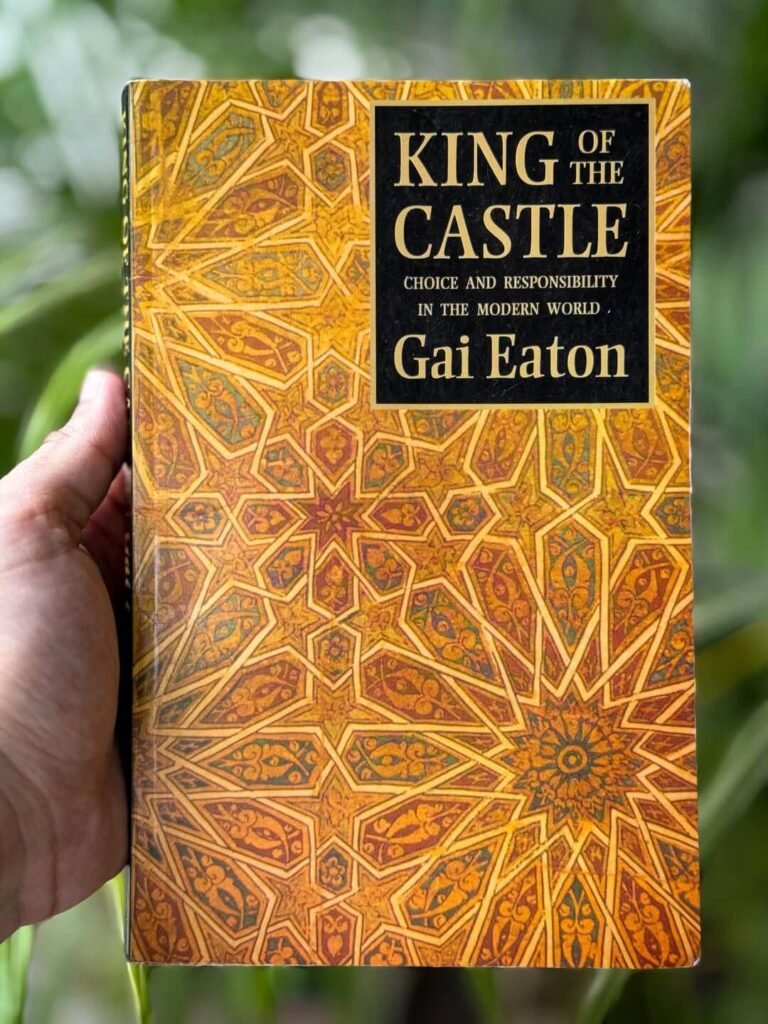
Few books have the ability to surface the assumptions we have never thought to question, the ones so deeply embedded in modern life that they no longer feel like assumptions at all. King of the Castle is one of them. It makes us realise just how much of our thinking has been inherited rather than chosen. The author — Charles Le Gai Eaton — born in Switzerland, educated at Cambridge, diplomat, journalist, and revert to Islam, writes with the authority of a man who has lived inside Western civilisation long enough to see through it. He takes our assumptions, the ones we have never thought to question, and holds them up to the light.
Eaton himself acknowledged in the introduction that the book cannot easily be confined to a single category. It moves through history, philosophy, sociology, spirituality, theology, and cultural criticism, weaving them together around a single enduring question of what it means to be human in the modern age. Yet, despite the breadth of its concerns, the book maintains a coherent centre: the question of human responsibility in a world increasingly dominated by systems, institutions, and materialist assumptions.
The book’s central argument is straightforward: modern secular society has dispossessed the human being of his true identity and replaced it with something far smaller. Man, in the traditional view that Eaton defends, is God’s Viceroy on Earth, a being of moral depth, spiritual responsibility, and genuine freedom. What modernity has made of him is something closer to a unit of economic function, valued for his productivity and managed by systems too large and diffuse for any single person to be held accountable within them.
This reduction is not accidental. Eaton shows how secular societies have quietly assumed the totalising claims once belonging to religion, demanding loyalty, shaping identity, leaving no space outside their reach, while stripping away the spiritual framework that gave such claims legitimacy. The citizen is made to feel free while being comprehensively possessed. And the great enabler of this possession is the modern tendency toward collective anonymity:
Of all the changes that have taken place in the human condition over the past hundred years none is more significant than the increasing difficulty we now have in tracing acts to their owners. In earlier times and in more simple societies each act was branded with its owner’s name. In the complex societies of today it might take the combined efforts of a detective and a moral philosopher to trace any given act to any one person. The State, the society or the organisation acts. ‘They’ act. But ‘they’ cannot be loved or blamed or touched. The need to attribute acts to men or women like ourselves finds no satisfaction.
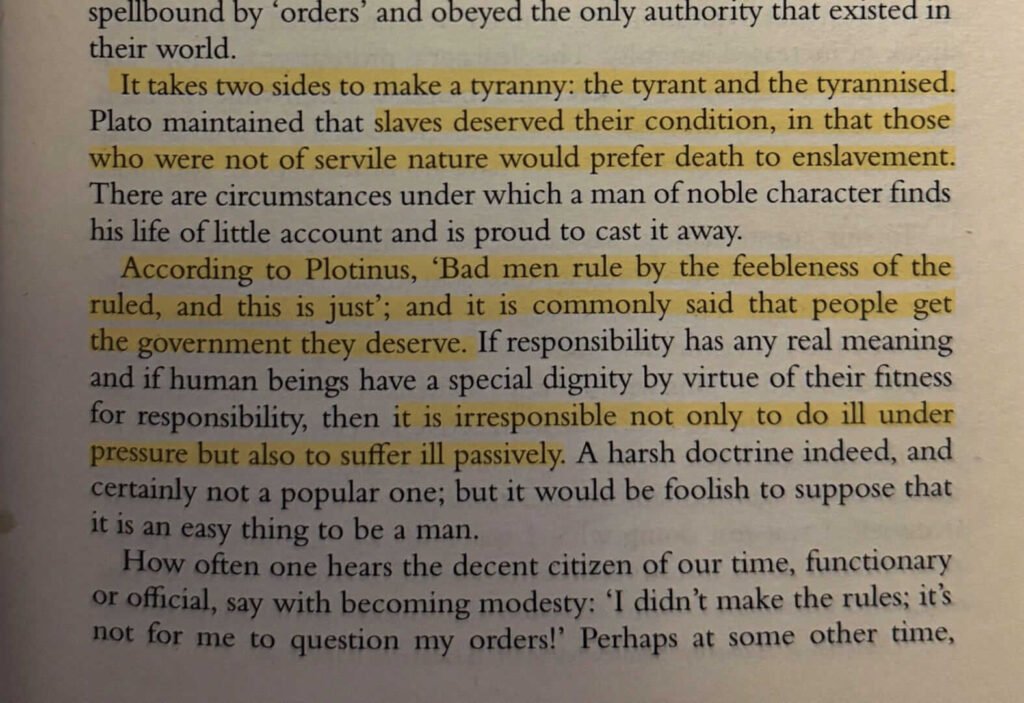
From this flows one of the book’s most morally urgent arguments. A society of jobholders and functionaries, absorbed into vast collectivities, produces men who have learned to outsource their conscience. Eaton is unsparing at this point:
How often one hears the decent citizen of our time, functionary or official, say with becoming modesty: ‘I didn’t make the rules; it’s not for me to question my orders!’ Perhaps at some other time, in some other place, one might applaud his sense of duty; but too much has happened in the past forty years, and we have seen too much of what dutiful obedience may involve, and we have lost our innocence.
The man who simply follows orders has not absolved himself. He has chosen not to choose, and that too is a choice with consequences.

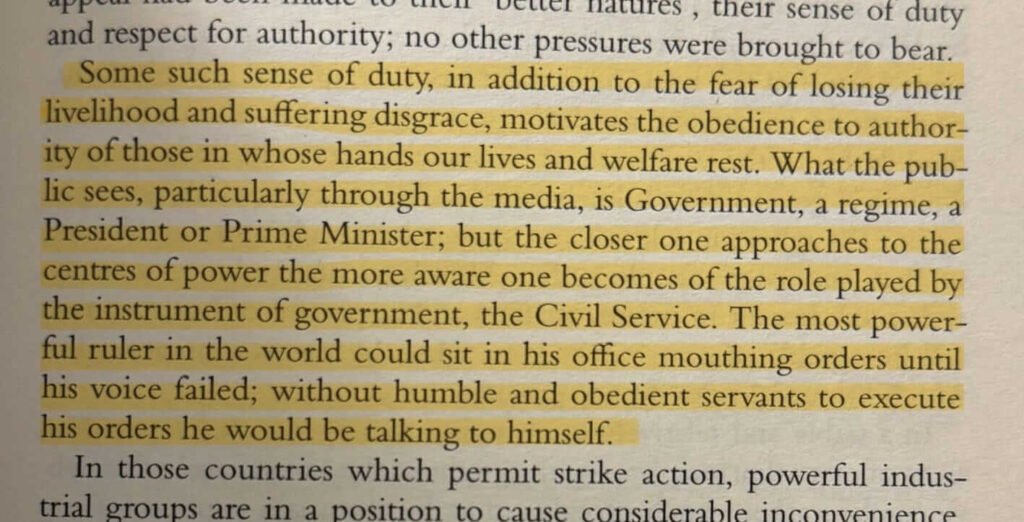
Eaton presses this further by asking a question the modern legal mind prefers to avoid: who made the laws? Laws change constantly. What was criminal becomes permitted; what was permitted becomes forbidden. If law has no reference point beyond the will of whoever currently holds power, it has no real claim on conscience. Obedience to it is then nothing more than submission to force, dressed up in the language of civic duty.

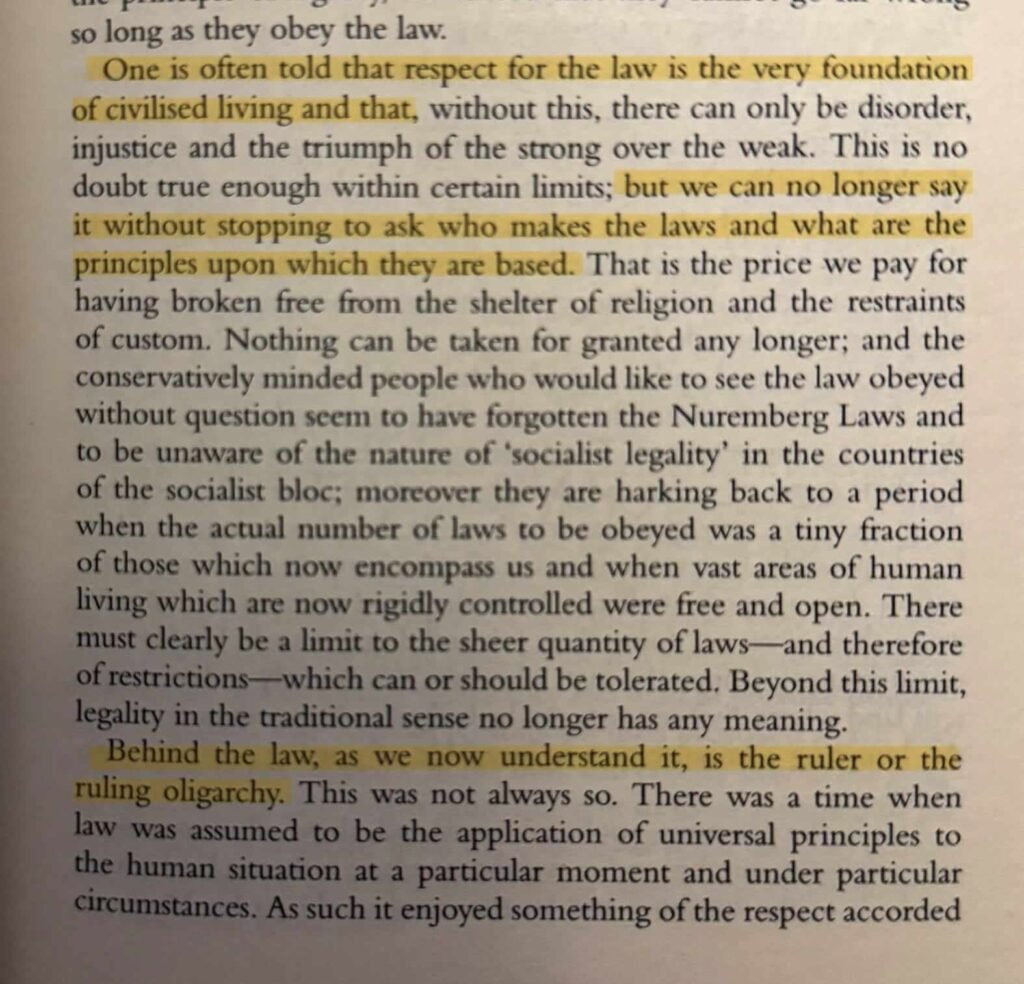
At the heart of the book lies the Islamic concept of man as God’s viceroy on Earth. This idea forms the spiritual and philosophical core of the work. Eaton presents the human being not as a random biological accident or merely an economic unit, but as a moral and spiritual creature entrusted with responsibility and freedom.
Men are creatures made for choosing and are, as such, responsible beings, accountable for what is in their little world, but with a responsibility which extends far beyond its limits since we are not, by nature, entirely confined in our mortal shells.
This is the book’s heartbeat; the capacity to choose, freely, responsibly, with awareness of something beyond the merely material, is what makes us human. A society that keeps its citizens in permanent flux, where values shift and nothing holds still, quietly destroys that capacity. Not through tyranny, but through disorientation.
For Eaton, this freedom to choose is essential to human dignity. Modern systems may attempt to shape, condition, or absorb individuals, but the human soul cannot be reduced entirely to social machinery. The traditional understanding of man as steward and moral agent stands in direct opposition to a worldview rooted purely in materialism.

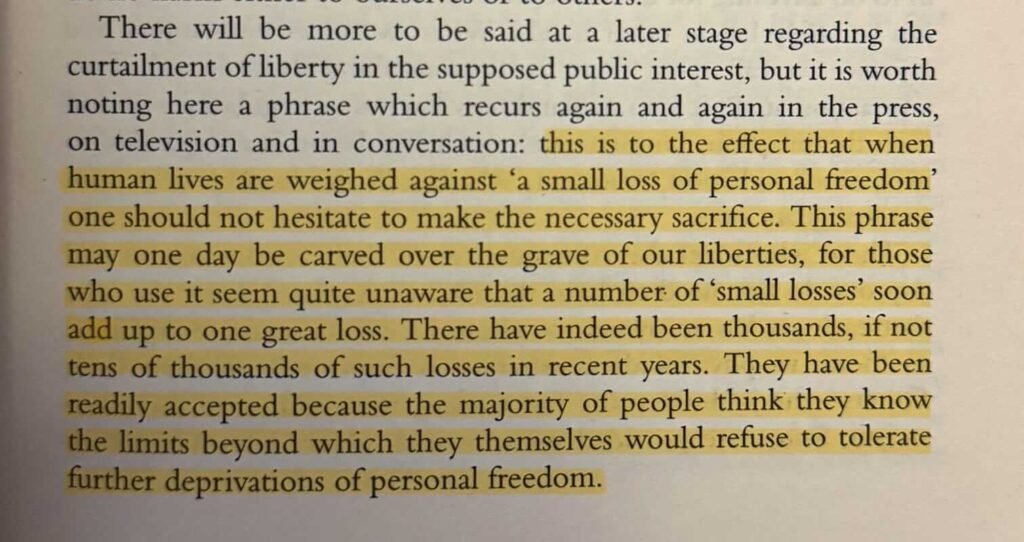
This section of the book is where Eaton’s synthesis of Islamic theology, philosophy, and social criticism becomes most powerful. Rather than presenting religion as a private emotional refuge, he presents it as a framework for understanding reality itself. The sacred, in Eaton’s view, is not an optional addition to human life but its organising principle. Without it, societies lose not only transcendence but coherence.
This connects to Eaton’s broader dismantling of the myth of progress. The modern world operates on an assumption that things are improving, that later is always better than earlier, that history moves upward. Eaton shows this to be an assumption, not a fact, and a historically unusual one at that. Most traditional civilisations understood time very differently. He does not romanticise the past, but he insists that the worship of the new has come at an enormous cost, severing people from accumulated wisdom and leaving each generation convinced it has nothing to learn from those who came before. The image he reaches for is precise:
‘Squatting in this place, this little pool, and hungry for certainties, people hold on with a kind of desperation to the current notion of what is (or what is not) ‘rational’; and yet, ‘the rationalism of a frog at the bottom of a well consists in denying the existence of mountains’; this is logic of a kind perhaps, but it has nothing to do with reality.’
The myth of progress also requires a reckoning with the twentieth century’s actual record. The modern world congratulates itself on having moved beyond religious violence, yet the bloodiest century in human history was also its most secular. Stalin, Hitler, Mao, none killed in the name of God. They killed in the name of ideology, nation, race, and class. Eaton asks the reader to sit with that fact. The charge of fanaticism and mass violence laid at religion’s door belongs, by any honest accounting, far more heavily to secular political ideologies. Nationalism, in particular, he regards as one of the most dangerous of modernity’s substitution of religions, taking the human hunger for belonging and the sacred, and redirecting it toward something partial and contingent, with catastrophic results.

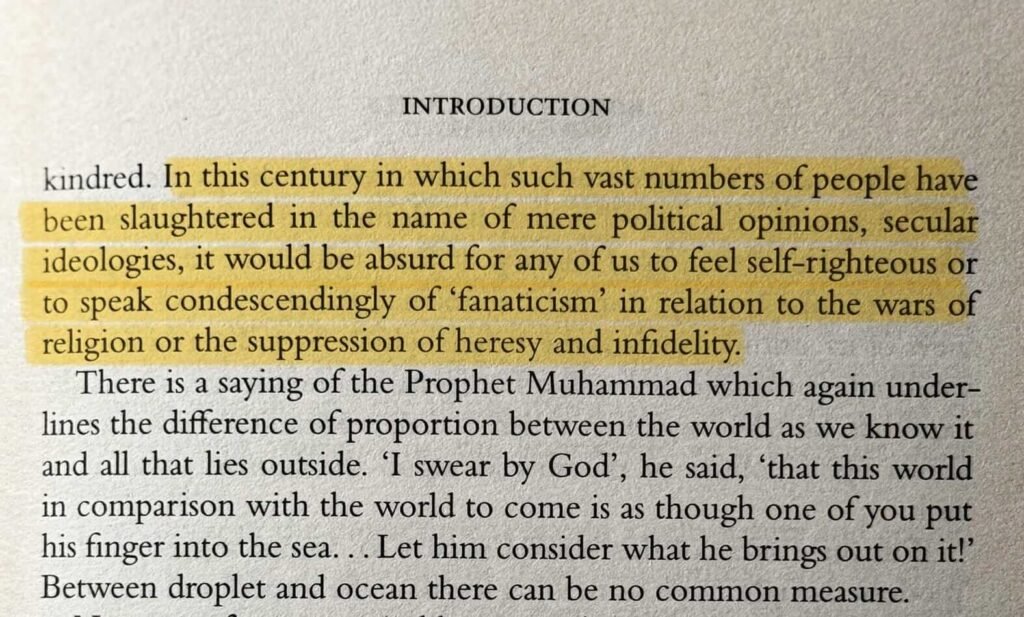
Technology compounds all of this. Eaton challenges the assumption that technological advancement necessarily represents human progress, and unequivocally writes on what it has enabled: evil at a scale and efficiency previously unimaginable. The capacity to administer atrocity with bureaucratic tidiness, to wage industrialised war, to surveil and manage entire populations, these are gifts of a civilisation that mastered technical capability while abandoning the moral framework needed to govern it. The problem was never the machine. It was always the man behind it, now stripped of any sacred reference point.
Eaton has also questioned the superiority modern societies often claim over ancient civilisations. One of the book’s recurring strengths is its refusal to accept fashionable assumptions simply because they are fashionable. Eaton rejects simplistic evolutionary narratives of history and argues that ancient people possessed forms of wisdom and metaphysical understanding that modern societies have largely abandoned.
Another aspect brilliantly articulated by Eaton in King of the Castle was that of our relationship not just with humans, but with animals and with the environment too. He writes in the book:
The world is full of mirrors and the animal creation shows us our own reflection….One of the earliest of the Muslim Sufi Masters told his disciples, ‘When I commit a fault, I am made aware of it by my donkey’s temper’, and the Islamic tradition is full of stories to illustrate the manner in which the animals hold up a mirror to man and reflect in their behaviour the success or failure of his manhood.

Throughout King of the Castle, Eaton’s prose is a pleasure: direct, elegant, at times even sardonic, but always precise. He draws on Islamic theology, Western philosophy, literature, and history without ever feeling like he is assembling a bibliography. Readers who are firmly secular may find his religious premises difficult to accept as a starting point, and those expecting prescriptions will find the book more diagnostic than remedial. But that, perhaps, is the point. Eaton is not telling us what to do. He is asking us to see clearly, and then to choose.
King of the Castle has grown more relevant since its publication, not less. It remains one of the most honest, courageous, and beautifully written critiques of the modern world.
King of the Castle: Reviews by Readers
- This book clarifies the job of man as a viceroy in this world. Divided into 8 sections, each section dwells on the problems of human in the 21st century and how it is important for men to wake up to their true niche. Much of what I’ve been questioning in my life has been in this book and it is clarified in a way that only certain people can. There is no inch of a doubt that this man’s grasp of the English language will affect you and his intellect will astound you.
- Gai Eaton’s words reminded me that as a Muslim, I have a moral duty to speak truth to power and that this applies in all spaces, especially those that seek to promote a version of living that is contrary to that of God consciousness. In a world obsessed with profits over people, where injustice is rife and where there are attempts to create monolithic cultures that have no space for difference, this book reminded me of the importance of choice and resisting a narrative that says only a particular type of citizen who conforms is acceptable.
- A life changing book for sure. A great study of the modern day and the modern man’s struggle within the prevailing materialistic culture, along with its numerous challenges and its hostility to the spiritual. In the author’s own words in his introduction, this work cannot be classified into a certain category, nor does it cover a single topic. It touches upon social sciences, history, spirituality and philosophy; weaving them together into a strong mesh of ideas, thoughts, and calls for personal and communal action to change these strange times towards the better, or rather steer them away from this materialistic decline, towards a spiritual incline.
- This was one of the most incredible and most profound reads of my life so far. I had to stop myself and slow down the reading to digest what my mind was capturing. He combines beautifully poetry, critical thinking, Islamic theology and a deep understanding of the ‘modern mind’. It is as he was speaking directly to our generation. My book is now full of annotations, and I know I will want to go back to it in a few years, God willing. Absolutely life changing book, and full of beauty.
- Eaton takes all our illusions (and delusions) and puts them in front of us. Slight feel of unease reading this because everything he says hits home.
- King of the Castle is not a comfortable book, nor is it meant to be. It is, rather, a bracing and beautifully written challenge to the reader to examine the foundations on which they have built their understanding of the world. For anyone willing to engage seriously with questions of meaning, responsibility, and the place of the sacred in human life, it remains an essential read.
- This book compelled me to question the direction that modern society is heading towards, as well as to reconsider the ideals that we are taught to aspire towards achieving. It puts accepted contemporary ideas to the test and presents valid arguments to make clear, the contradictions present within them.
- The books highlights problems of modernity and material outlook of the modern world. It points out to differences between ancient people and modern people. Eaton shows that ancient people were not as ignorant as it is presented today. He rejects the evolutionary representation of the human history and provides well-substantiated arguments for the opposite case.
This book review was first published on Bahaaristan’s Substack. Subscribe to our Substack newsletter to receive all updates directly in your mailbox.