


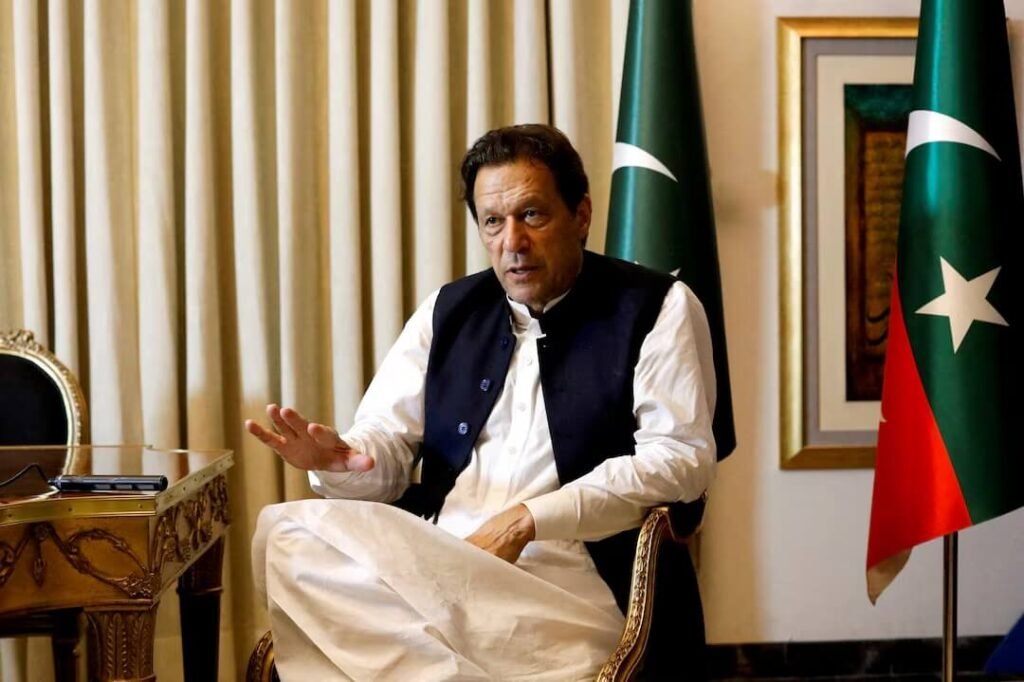
The United Nations (UN) Human Rights Council’s Working Group on Arbitrary Detentions has deemed former Pakistan Prime Minister Imran Khan’s detention arbitrary and in violation of international law.
It further called for his immediate release.
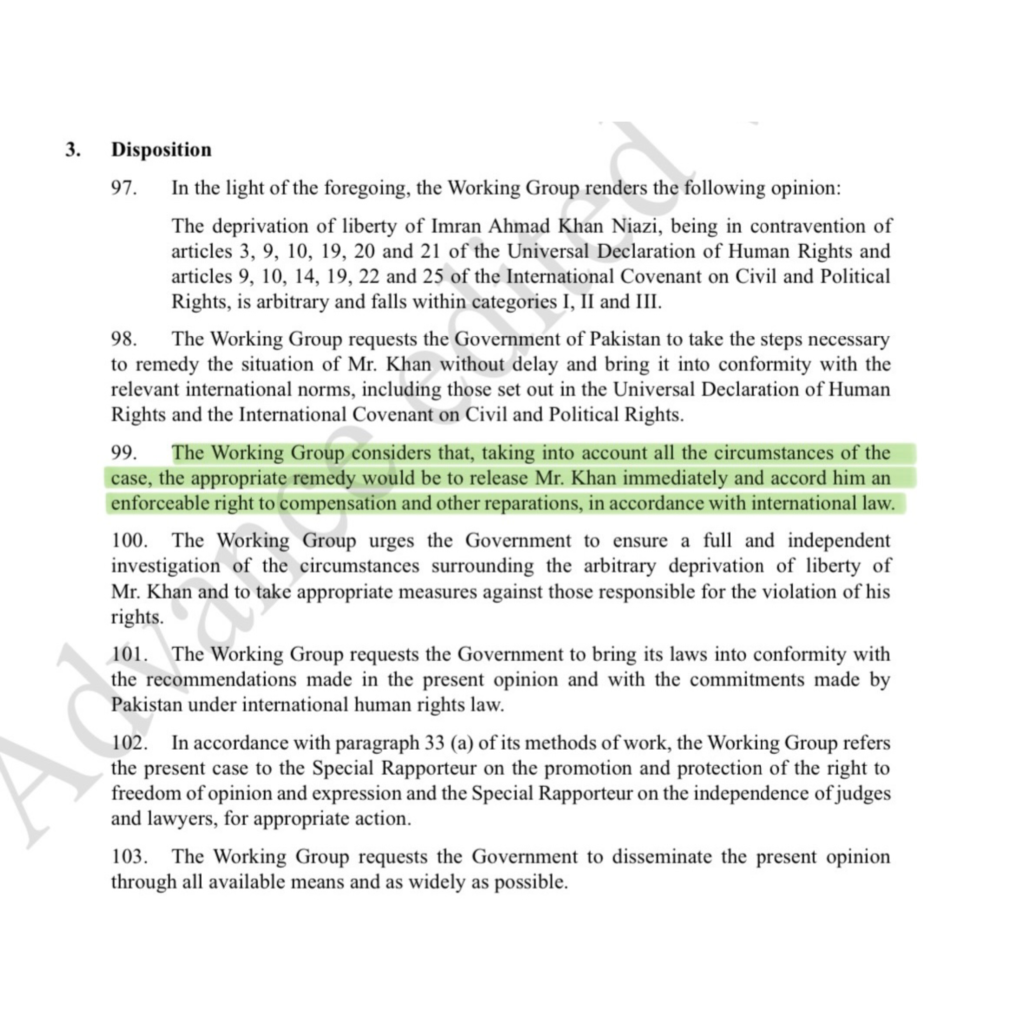
The Geneva-based United Nations Working Group on Arbitrary Detention said that Imran Khan’s legal battles were part of a “larger campaign of repression” against him and his PTI party and that the “appropriate remedy would be to release Mr. Khan immediately and accord him an enforceable right to compensation and other reparations, in accordance with international law.”
Findings of the UN Working Group
The UN Working Group on Arbitrary Detentions has deemed ex-Pakistan PM Imran Khan’s detention arbitrary & in violation of international law. It further called for his immediate release.
Here are further conclusions & findings by the Working Group
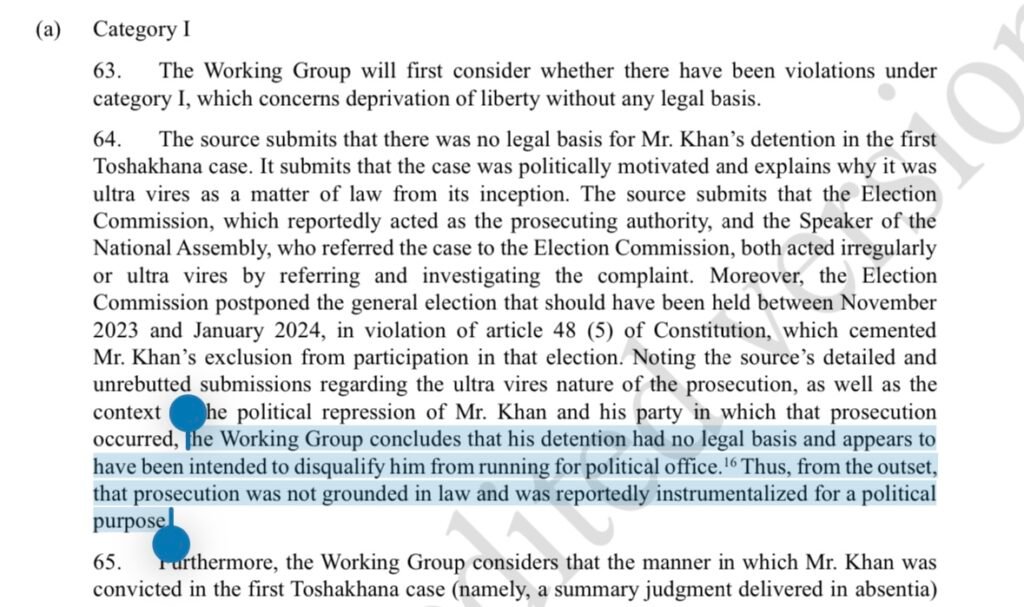
In section 2, clause 64, the UN working group concludes that Imran Khan’s detention had no legal basis & appears to have been intended to disqualify him from running for political office. The prosecution was not grounded in law & was instrumentalized for a political purpose.

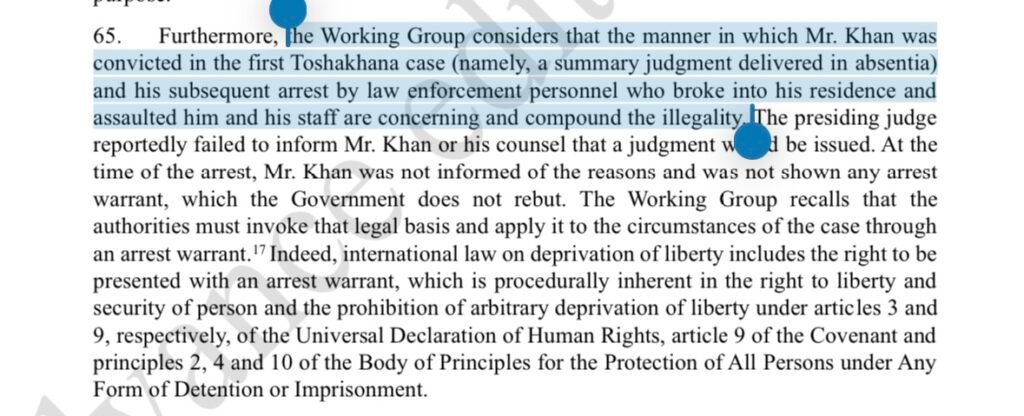
In section 2, clause 65, the UN working group deemed that the manner in which Imran Khan was convicted in the first Toshakhana case & his subsequent arrest by law enforcement personnel who broke into his residence & assaulted him & his staff are concerning & compound the illegality.

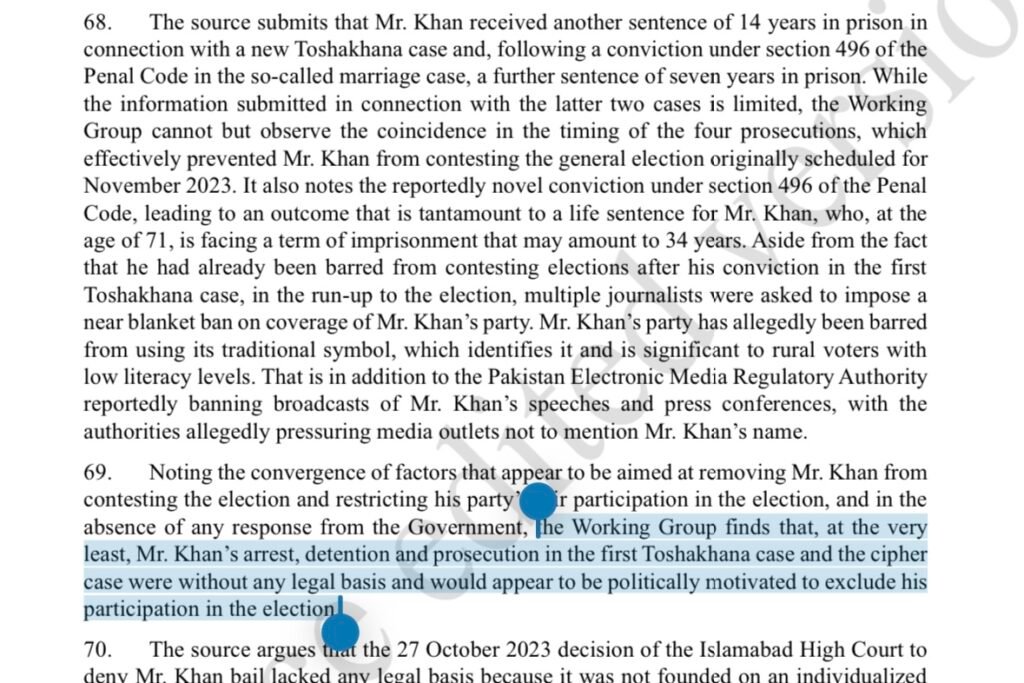
In section 2, clause 69, the working group finds that Khan’s arrest, detention & prosecution in the first Toshakhana case and the Cipher case were without any legal basis and were politically motivated to exclude his participation in the election.

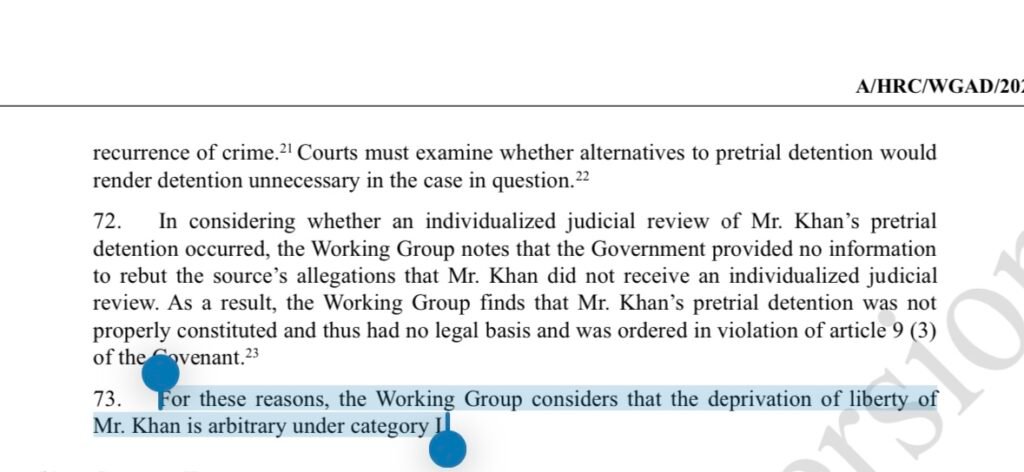
In section 2, clause 73, the working group concluded that Imran Khan was arbitrarily deprived of liberty.

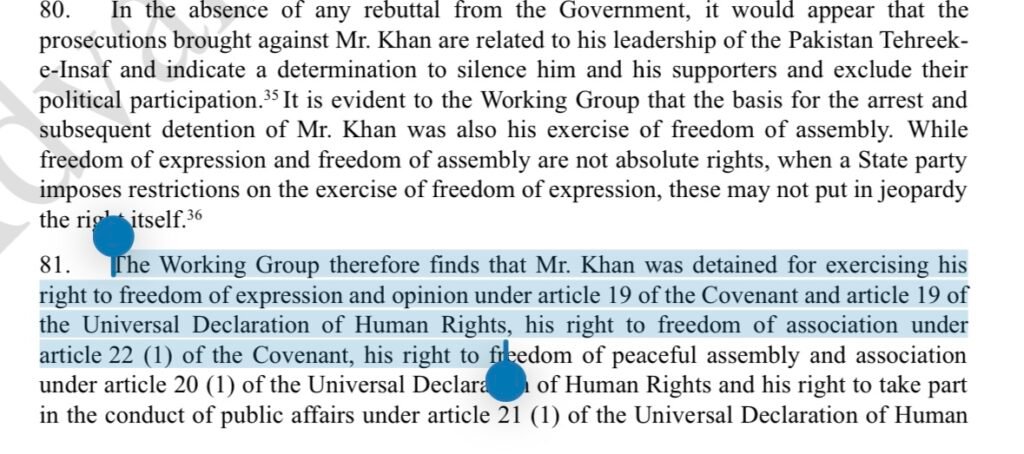
In section 2, clause 81, the working group notes that Imran Khan was detained for exercising his right to freedom of expression & opinion under, the right to freedom of association, the right to freedom of peaceful assembly and association & to take part in conduct of public affairs.

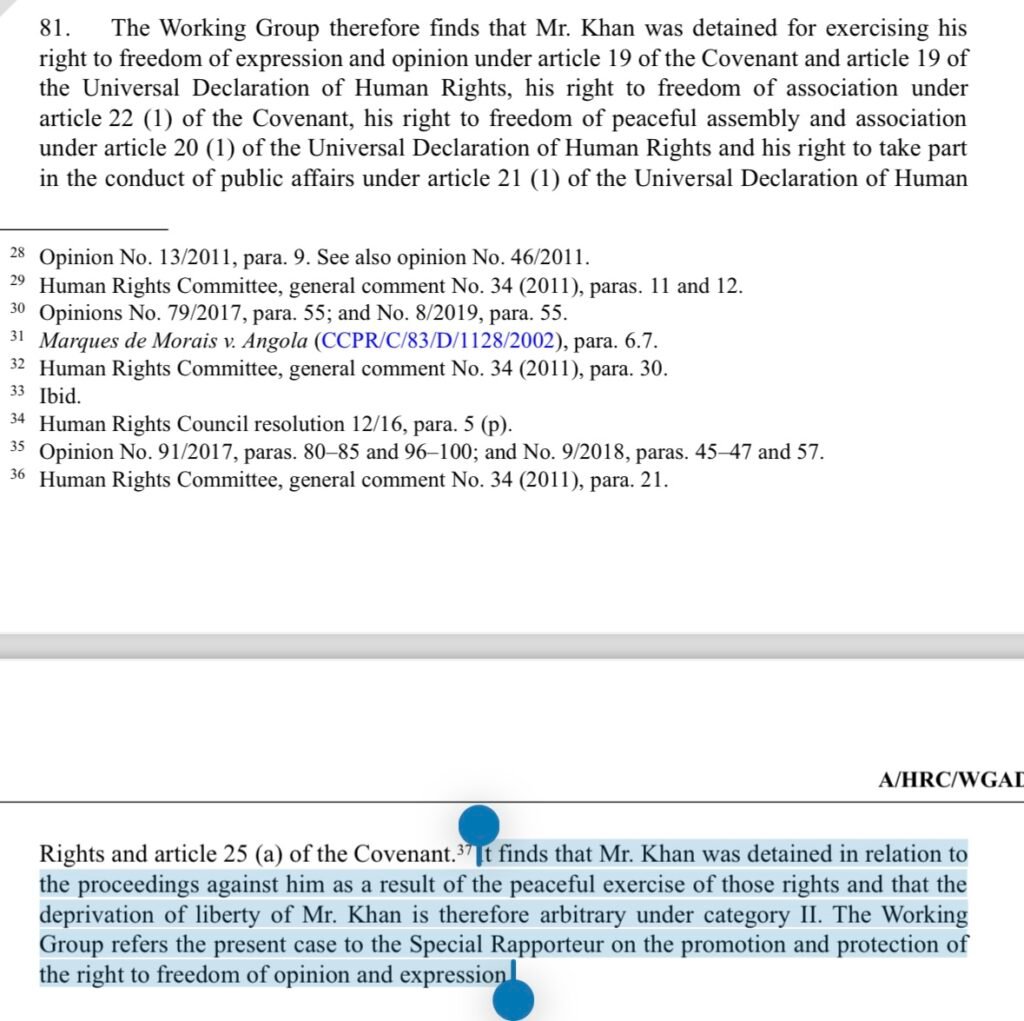
In the same clause, it concludes that Imran Khan was detained in relation to the proceedings against him as a result of the peaceful exercise of rights & that the deprivation of liberty of Imran Khan is therefore arbitrary.

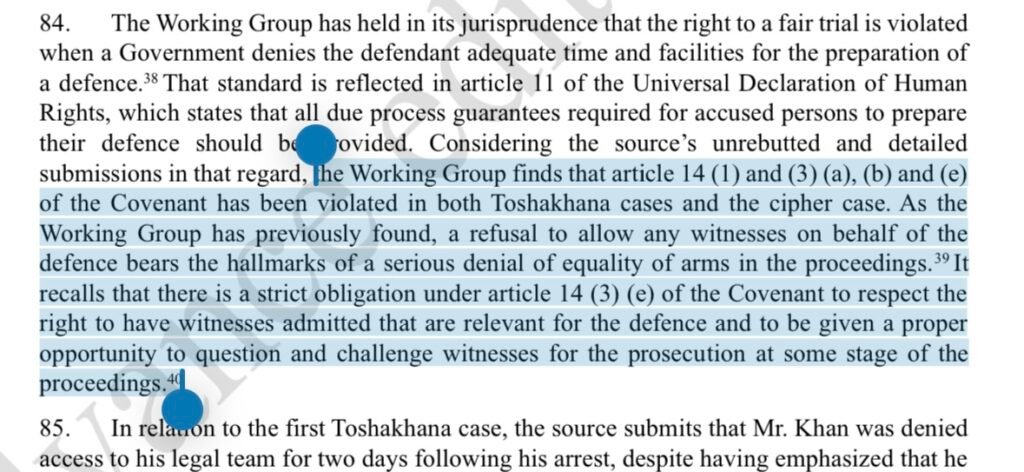
In clause 84, the UN working group finds that articles 14 (1) and (3) (a), (b) and (e) of the Covenant have been violated in both the Toshakhana cases and the Cipher case.
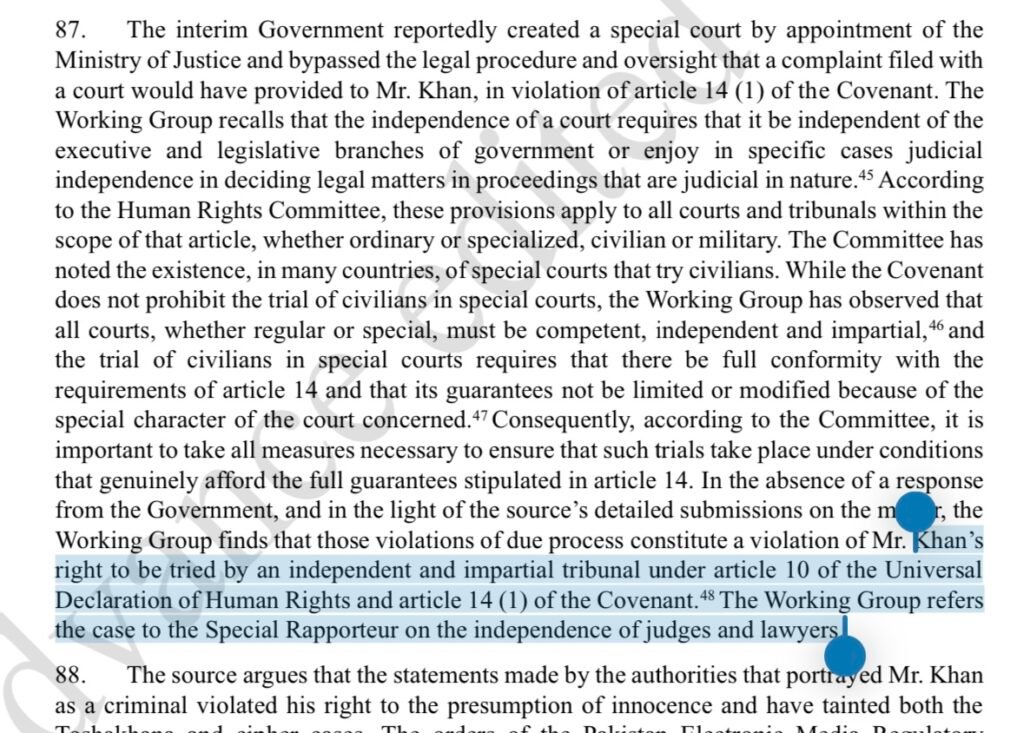
In clause 87, the working group finds that the violations of due process constitute a violation of Mr. Khan’s rights to be tried by an independent and impartial tribunal under Article 10 of the Universal Declaration of Human Rights and Article 14(1) of the Covenant.

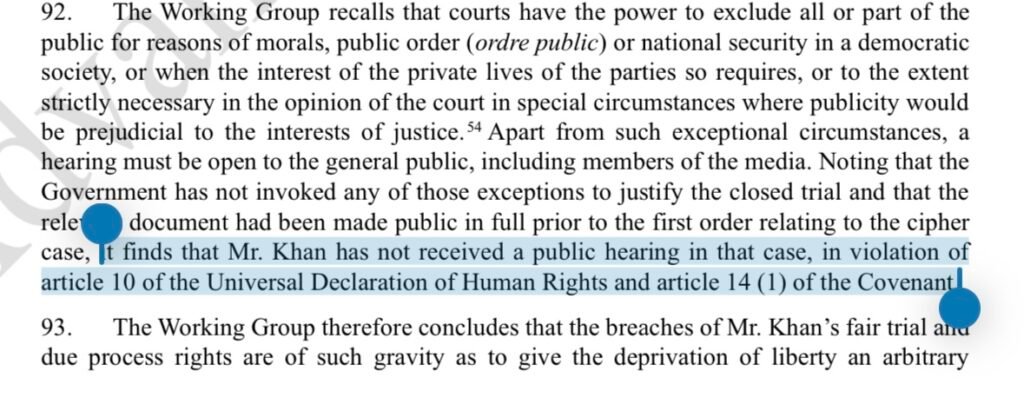
In clause 92, the working group finds that the fact that Imran Khan has not received a public hearing in his case(s) is in violation of Article 10 of the Universal Declaration of Human Rights and Article 14(1) of the Covenant.

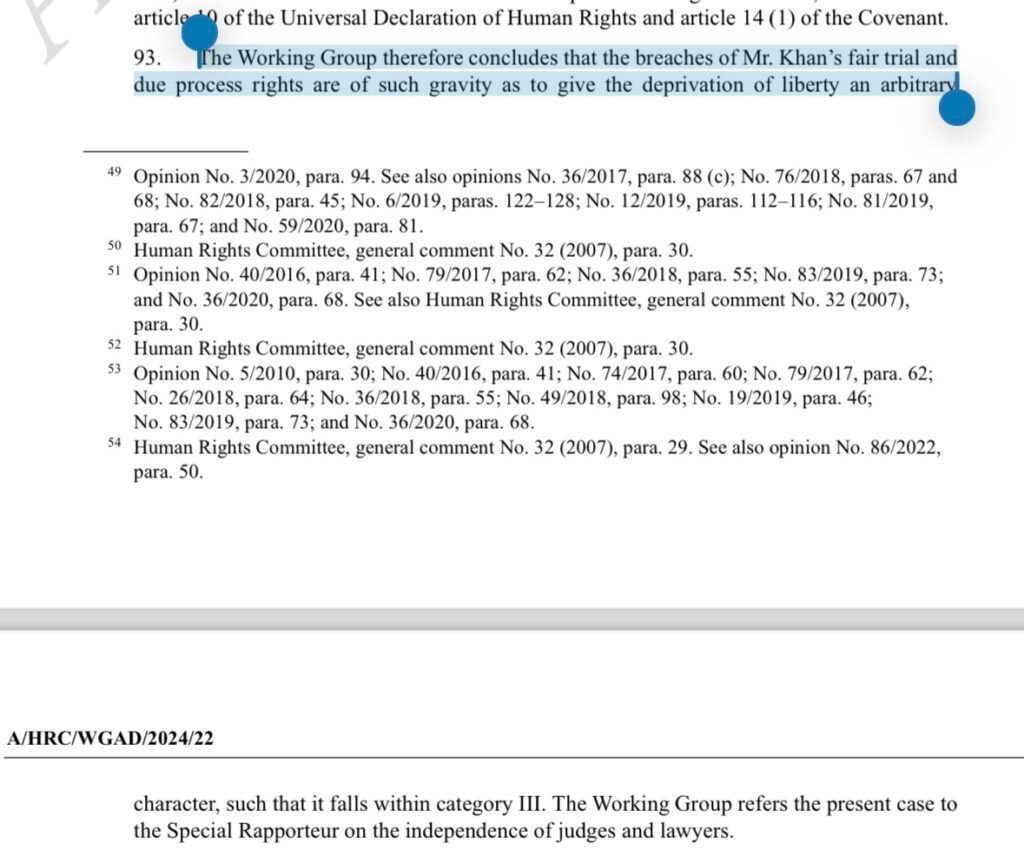
In clause 93, the working group concludes that the breaches of Mr. Khan’s fair trial and due process rights are grave and that his detention is arbitrary.

The UN working group concluded by recommending the immediate release of Imran Khan, paying reparations to him, and has urged the Pakistani government to take measures against those who deprived him of his rights.

What has happened in Pakistan recently?
- Pakistan’s elections were blatantly rigged, and the people’s mandate was brazenly stolen. At the moment, an illegitimate setup has been imposed on 240 million people at the behest of Pakistan’s powerful military.
- Imran Khan has been in jail since August 2023 and was convicted in some cases ahead of a national election in February. He is also fighting dozens of other politically motivated cases that are continuing.
- In recent months, Pakistani courts have suspended Khan’s jail sentences in two cases about the illegal acquisition and sale of state gifts, and also overturned his conviction on charges of leaking state secrets.
- However, Imran Khan has remained in prison due to a conviction in another absurd case – that of an unlawful marriage, in which a trial court ruled that his marriage in 2018 was unlawful. Khan also faces a trial under anti-terrorism charges in connection with violence in May last year.
- Imran Khan came to power in 2018 and was ousted in 2022 after the Pakistani military orchestrated a regime change operation at the behest of the US administration.
- Despite not running himself, candidates backed by Imran Khan secured the highest number of seats, but the Pakistan Muslim League-Nawaz (PML-N) and Pakistan Peoples Party (PPP) have formed the federal government after blatant electoral fraud through Form-47.
- The U.S., Britain and the European Union expressed grave concerns about the reported irregularities and the widespread fraud in the elections and urged a probe while United Nations Secretary-General Antonio Guterres expressed concern about violence and the suspension of mobile communications services during the elections.