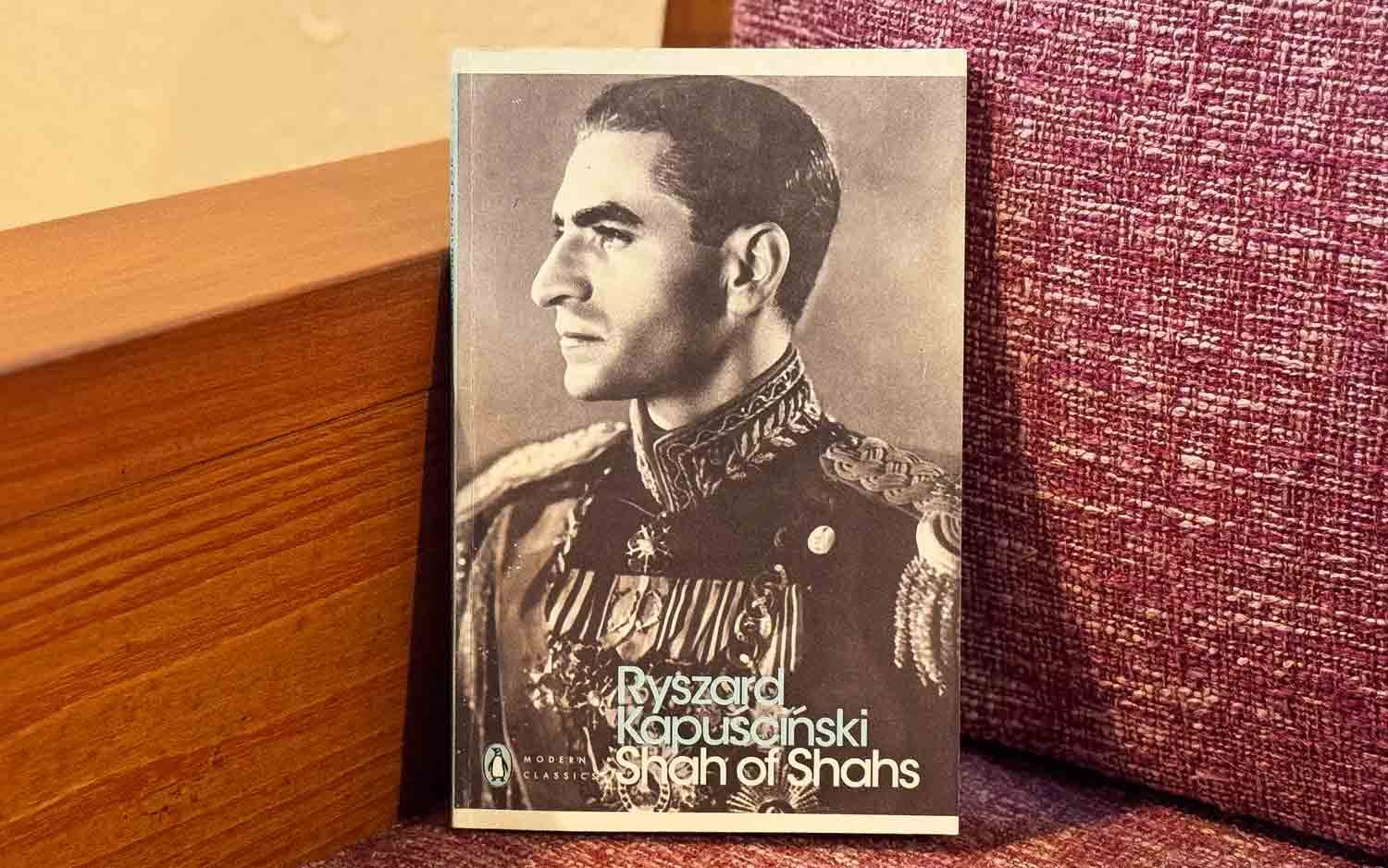
Shah of Shahs is the story of the Iranian Revolution; of the rise and fall of the last Shah of Iran, Mohammad Reza Pahlavi, or more significantly, of the people he subjugated and their eventual uprising.
Ryszard Kapuściński, as a foreign reporter for the press agency of Stalinist Poland, was a witness to the Iranian Revolution, along with 26 other revolutions and coups across the so-called third world. During his lifetime he was jailed 40 times and survived four death sentences.
In Shah of Shahs, Kapuscinski brings a mythographer’s perspective and a novelist’s expertise to the overthrow of the last Shah of Iran, one of the most infamous of the United States’ client-dictators. Shah had resolved to transform his country into “a second America in a generation.” However, Kapuściński paints Shah almost as a tragic figure, who possessed immense power, especially after the consolidation of his rule following the 1953 Iranian coup d’état, and yet he remained deeply insecure and increasingly isolated from the people he governed. The Shah spoke of building a Great Civilisation, and yet remained completely detached with the realities of the Iranian society.
From his vantage point at the break-up of the regime, Kapuscinski gives us a compelling history of conspiracy, repression, fanaticism, and revolution. But he goes beyond just reporting events asks questions best answered by the human psyche: here’s what we see, but what does it mean or will result in? What does oppression do to people? How does fear spread? How does it disappear? And quite superbly, he answers those too.
Words that open one’s eyes to the world are always easier to remember than any other words.
(p.36)
He masterfully dissects the psychological both individual and collective psychology. He shows how each person felt as a result of Shah’s horrific oppression, and how they began to gain confidence in groups and crowds, finding strength and safety in crowds and in security of mosques. His central suggestion is that revolutions do not erupt overnight; they occur when a regime finally exhausts the patience of its people.
Iranians are a proud people and they are extremely sensitive when their dignity is at stake. An Iranian never admits that he cannot do something; he considers such an admission to be a source of shame and dishonour. He suffers, grieves, and in the end, hatred takes root in his being.
(p.59)
The book is structured like a cathedral triptych. The opening and closing sections serve as thin yet devastating historical commentaries, while the middle section contains reflective and emotive responses to fragments of conversation overheard, photographs and newspaper clippings he collected, crumpled pieces of paper bearing discreet scribblings, and anecdotes relayed directly. With these scraps, Kapuściński manages to quilt together, as accurately as possible, the overall mood of the country and the hearts of its people.
In authoritarian societies, the goal of progress is to strengthen the state and its means of repression, and it leads to tyranny, submission, sterility, ambiguity, and the emptiness of life.
(p.65)
The Pahlavi Dynasty of Iran
The Pahlavis, whose exiled scions are to this day yapping at the behest of their American masters, were but a speck on the timescale of Iran’s 2,600 years-long history.
The founder of the dynasty, colonel Reza Khan, launched a coup d’état at the behest of British imperialism and installed himself in 1925 as Shah Reza the Great, Shah of Shahs, Shadow of the Almighty, God’s Vicar and the Centre of the Universe.
Greedy for land and money, Shah Raza launched a reckless modernising effort to establish a strong army, while simultaneously undercutting the influence of the mullahs over the people. His heavy-handed methods included banning traditional Iranian dress, forcing the population to adopt European clothes, ordering police to tear chadors off women, and many other acts of senseless repression.
Kapuściński summarises the programme of Reza Khan with characteristic bluntness:
In his own brutal words, he wants to put the ignorant mob to work and build a strong modern state before which all will beshit themselves in fear.
However, “Empire giveth; empire taketh away”, as the the author wryly remarks.
The British deposed Reza Khan in 1941 and installed his son, Mohammad Reza. Shah of Shahs does a remarkable job of conveying the narcissism and megalomania of Mohammad Reza Pahlavi. While his father came from a humble background, the second Pahlavi was born into a bubble of wealth, prestige, and power.
He loved reading books about himself and looking through albums published in his honor. He loved unveiling his monuments and portraits. Catching a glimpse of the monarch’s likeness was nearly unavoidable. To stand in any given place and open your eyes was enough: The Shah was everywhere.
His rule was nonetheless disrupted in 1953, when Iran voted heavily in favour of Prime Minister Mohammad Mossadegh, who attempted to nationalise Iranian oil, wresting it from British control. Mossadegh was promptly removed through a concerted effort of Anglo-American imperialism, and the Shah returned to install a totalitarian regime that only a few could rival.
Today, young people who were supposed to know nothing about Mossadegh die with his photo in their hands. This is the best document to understand where the purification and rewriting of history is leading. But the Shah did not understand this. He did not understand that even if you erase and destroy a person, you still cannot prevent his existence. On the contrary, it can be said that by doing these things, his image in the minds of the people becomes more and more colorful. These are contradictions that no dictator can do anything about.
(p.35)
Kapuściński’s writing makes you feel the cloud of fear and oppression as though you could reach out and cut through it:
The ubiquitous terror drove people crazy, made them so paranoid
they couldn’t credit anyone with being honest, pure, or courageous. After all,
they considered themselves honest and yet they couldn’t bring themselves to
express an opinion or a judgment, to make any sort of accusation, because
they knew punishment lay ruthlessly in wait for them. Thus, if someone
verbally attacked and condemned the monarch, everybody thought he was an
agent provocateur, acting maliciously to uncover those who agreed with him,
to destroy them.
The regime’s grip was initially strengthened by a period of economic boom. Pahlavi Iran became a textbook case of uneven development: where brand new modern industries were being established next to villages that lacked even fresh water.
This chaos was overseen by a megalomaniac, an absolute monarch gripped by the delusion that he could modernise Iran to the level of the United States within a single decade. The fantasy was bankrolled by soaring oil revenues, which flooded the state coffers and drew a rush of foreign investors into the country.
A dictatorial government that destroys its intellectuals and culture leaves behind a barren wasteland in which the tree of thought will not grow anytime soon.
(p.58)
As entire oil refineries were imported from abroad, accompanied by vast purchases of advanced military equipment, ordinary Iranians experienced firsthand the deeply uneven nature of this development.
While the Shah’s court enjoyed virtually unlimited wealth and hosted some of the most extravagant parties in modern history, SAVAK, the secret police, whose brutality was often compared to that of the Gestapo, maintained control through intimidation and repression.
But as Kapuściński states, at some point, a point impossible to predetermine precisely, a harassed, terrified man suddenly breaks through his terror and stops being afraid. Without that moment, there would be no revolution.
“The causes of a revolution are usually sought in objective conditions – general poverty, oppression, scandalous abuses. But this view, while correct, is one-sided. After all, such conditions exist in a hundred countries, but revolutions erupt rarely. What is needed is the consciousness of poverty and the consciousness of oppression, and the conviction that poverty and oppression are not the natural order of this world.”
The spark, mundane and quite ordinary in itself, was an article in a government newspaper crudely attacking Ayatollah Khomeini. It ignited protests in Qom which were brutally suppressed. The deaths were mourned, and on the 40th day during a mourning ceremony, the mourners were attacked by authorities, causing more deaths. And more mourning ceremonies followed, and more clashes, and more funerals. This cycle repeated and spread across Iran, and within a year, the Shah was forced to flee the country.
More insights from Shah of Shahs
One observation that is particularly striking is Kapuściński’s description of when fear suddenly disappears. For years, the regime had relied on intimidation through SAVAK. But at some point in one of the demonstrations, the protesters simply stopped being afraid of the police. The police shouted at the protesters, but the protestors just stood still there, instead of quietly dispersing. This moment became a psychological turning point. While the regime still possessed weapons and institutions, it had lost the fear of the populace that sustained its authority.
“…any dictatorship appeals to the lowest instinct of the governed: fear, aggressiveness towards one’s neighbours, bootlicking. Terror most effectively excites such instincts…”
(p.115)
Kapuściński further reflects that revolutions often destroy the old order before anyone clearly knows what the new order will look like. In Iran, the Shah’s fall briefly opened space for many competing visions. Some groups hoped for liberal democracy, others imagined a socialist future, and religious forces rallied behind Ruhollah Khomeini. But the revolutionary coalition was deeply divided, and in the end, the clerical movement proved to be the most organised force.
Even if you wipe out a person, you still cannot stop him from existing. On the contrary, it can be said that by doing so, his image in the minds of people becomes ever more vivid. These are contradictions that no tyrant can do anything about. The sickle strikes, the grass begins to grow again. You cut it again, and it grows again, even faster than before – the encouraging law of nature.
He also hints at a darker irony. The institutions of repression that existed under the Shah, most notably SAVAK, did not simply disappear with the revolution. New forms of control soon emerged under the Islamic Republic. The Shah was gone, but the mechanisms of power remained, essentially replacing one dictatorship with another. The people of Iran experienced centuries of oppression, betrayal, humiliation, and terror by rapacious monarchs, foreign imperialists, and now their mullahs. This hints at the premise that bringing sustainable change is a gradual process rather than something initiated through short-lived revolutions.
A despot may go, but no despotism disappears with the despot’s departure. The life of a dictatorship depends on the ignorance of the masses, and that is why all dictators work hard to increase this ignorance. Generations must pass before things change and light can penetrate. In any case, until such a time, those who overthrow a dictatorship – without wanting to – often act as if they were its heirs, perpetuating the attitudes and thought patterns of the era they themselves destroyed. This happens so unintentionally and unconsciously that if someone points it out to them, they go berserk with a straight face.
(p.136)
Beyond the Shah of Iran, Shah of Shahs contains valuable observations about the nature of dictators and the dynamics of popular movements, observations that remain relevant and draw parallels with contemporary issues.
Critique of Shah of Shahs
For all wonderful accounts, there were some generalisations made by Kapuściński, that perhaps would not sit too well for several readers. He was giving pieces of understanding of Iran, some brief account of the country’s history that goes up until the Iranian evolution and the deposition of the last Shah, using, for sure, a lot of secondary sources. This knowledge didn’t come from his first-hand encounter with Muslim world. It was the preconceived impression that carried so much of the traditionally biased views of the “Orientals,” of Islamic world, developed by the West since the 18th century.
An Iranian never surrenders to another Iranian. Everyone believes only in their own superiority, wants to be the first and most important, wants to impose their unique self on everyone. Me! Me! I know better, I have more, I can do anything. The world begins with me, I am the whole world. Me! Me!… Iranians, no matter what group they are in, immediately carve out a hierarchy for themselves. I am first, you are second, you are third. The second and third do not object, but immediately begin to sniff, plot, and trick to bring down number one. Number one must take a stand to stay on top. Take a stand and shoot the guarantor of his gun.
(p.40)
Kapuscinski’s writings on Africa are great, perhaps because he was able to keep a somewhat fresher mind? Perhaps? For Iran, there was something amiss. It lacks the individuals, it lacks the personal observations and attachment. It lacks the very concrete “human” element. Instead, it is more like a general retelling, a big canvas that looks at the macro order and forgets the power of details.
Lastly, Kapuściński often uses depictions of daguerreotypes and stills to advance the narrative. You know how they say “a picture’s worth a thousand words”? Well, Kapuściński literally uses them, and yet not one of them actually became a part of the book.
Final Remarks
Kapusciński nails the fear, cruelty, and numbness that underlie such a regime. He creates the dark atmosphere of the times and relies on revealing the psychology of people in Tehran.
The writing is intense, concise, and highly stylised. It is not the kind of book you want to break up into too many readings. Finish it as fast as you can, because it is all about the feel. The best way we can describe it: Shah of Shahs is an incredibly moving, human account of two Iranian revolutions that ends with the sentence, “Oh f***!”
Surviving through 40 arrests and escaping four death sentences, Kapuściński gives us an unforgettable peek into the full, all-consuming and untamed process of a revolution, and its impact on the psychology of the masses and individuals.
Just keep your eyes open for statements that will hit a little closer to home. They are there, and it was chilling to realise how many of the key ingredients for future revolution are currently accumulating in various countries around the world at this very moment.