Between 1765 and 1947, famines in British India killed tens of millions of people, from the Great Bengal Famine of 1770 to the Bengal Famine of 1943.
Droughts have shaped agricultural life on the Indian subcontinent for millennia, governed by the unpredictable rhythms of the summer monsoon. And imperial apologists have seized on this fact to blame the famines on nature; on failed monsoon and withered crops.
Yet, this explanation leaves glaring questions unanswered, the foremost of which is how did a region that once produced a quarter of the world’s manufacturing output come to suffer chronic starvation. To answer this, historians and academics have looked beyond rainfall patterns. Subsequently, a substantial body of modern scholarship, anchored in the Nobel laureate Amartya Sen’s entitlement theory and Mike Davis’s Late Victorian Holocausts, has demonstrated that these famines, and the death that followed, were rarely a result of absolute absence of food. Instead, they were a product of greed and imperialism, manufactured first by the corporate ambitions of East India Company, and later by the British imperialist ideology that placed its imperialist endeavours above ecological vulnerability and basic humanity. It was these forces that made famines under the British Raj so frequent and so lethal.
Famines Under East India Company Rule (1765 – 1857)
The transformation began in 1765, when the British East India Company secured the Diwani—the right to collect taxes—in Bengal, abruptly shifting its identity from a trading enterprise to a territorial sovereign.
As the historian William Dalrymple writes:
The consequences of this ‘transaction’ were catastrophic. With no stake in the region’s governance or long-term well-being, the Company’s rule quickly became one of unrestrained plunder and wealth transfer westwards. Bengal, ravaged by war and struck by a devastating famine in 1769, was crushed further under heavy taxation. Company tax collectors committed what would be considered human rights violations in the process of collecting taxes.
Bengal’s famed artisans and weavers were reduced to near slavery, and its wealth was systematically drained to Britain.
A senior official of the old Mughal regime in Bengal wrote in his diaries:
Indians were tortured to disclose their treasure; cities, towns and villages ransacked; jaghires and provinces purloined: these were the “delights” and “religions” of the directors and their servants.
The Company’s governing mandate was to maximise revenue for its shareholders in London. That single imperative systematically dismantled the safeguards that had once protected the region against crop failure.
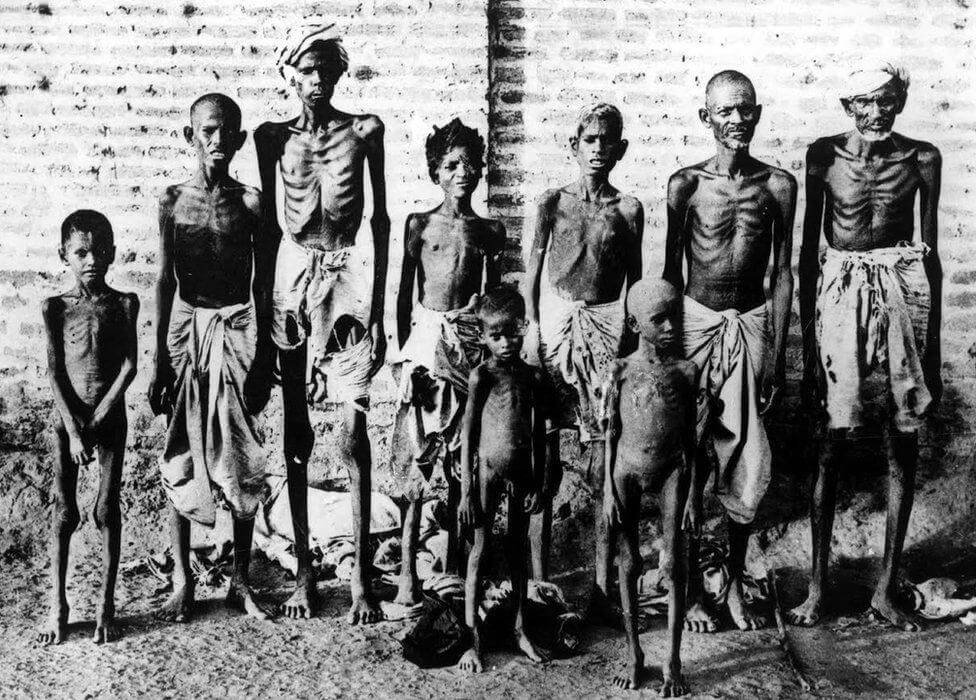
The Great Bengal Famine of 1770
Nowhere was this clearer than in the Great Bengal Famine of 1769–1770, which swept across Western Bengal and Bihar. When a severe drought withered the harvest, Company administrators refused to lower land assessments, and instead raised taxes to offset anticipated losses. As starvation spread, revenue agents forced destitute peasants to sell their remaining seed grain to meet tax demands, while Company officials cornered the rice market and sold grain at vastly inflated prices. Between two and ten million people, nearly a third of Bengal’s population, perished, and yet net tax revenue collected in 1771 actually exceeded pre-famine levels.
The Chalisa and Doji Bara Famines
Similarly, during the Chalisa Famine of 1783–1784, which devastated Delhi, Western Oudh, eastern Punjab, Rajputana, and Kashmir, as many as eleven million people died and vast swathes of northern India were left depopulated. Less than a decade later, the Doji Bara, or “Skull”, Famine of 1791–1792 struck the Company’s Madras Presidency alongside Hyderabad, Gujarat, Marwar, and the Deccan. Up to eleven million people died between 1788 and 1794. So immense was the mortality that survivors could neither bury nor cremate the dead, and skulls lay scattered across the landscape.
As the Company consolidated control over northern India in the nineteenth century, the Agra Famine of 1837–1838 claimed another 800,000 lives across the central Doab and trans-Jumna districts. It exposed the brittleness of an agrarian economy that had been stripped of its traditional grain reserves and tax remissions.
Famines under the British Crown Rule (1858-1870)
When the British Crown assumed direct rule over India after the War of Independence of 1857, imperial administrators held up rapid modernization, above all the expansion of the Indian Railways, as proof of a civilising mission. In theory, the rail network should have ended local famines by allowing surplus grain to be rushed into drought-stricken districts. However, in reality, the railways were built primarily to transport raw commodities from the interior to coastal ports for export, leaving starving regions isolated when markets failed.
Moreover, the British officials clung rigidly to the free-market orthodoxy and refused to interfere with the forces of supply and demand. The consequences became painfully clear during the Upper Doab Famine of 1860–61, which killed two million people across Agra, Delhi, Hissar and eastern Rajputana.
Just five years later, the Orissa Famine of 1865–1867 further demonstrated how deadly administrative inaction could be: it devastated Orissa, Bihar and the Bellary and Ganjam districts of Madras, claiming one million lives in Orissa alone and roughly four to five million across the wider region. The monsoon cut coastal Orissa off from imports by sea, yet colonial officials refused to intervene in grain prices or to import food, convinced on economic grounds and narratives that state interference would distort the natural course of trade.
Between 1868 and 1870, scarcity shifted westward. The Rajputana Famine of 1869 claimed 1.5 million lives, most of them in the princely states of Rajputana but also in the British-administered territories of Ajmer, western Agra and eastern Punjab, as desperate migrations overwhelmed local resources.
The Bihar Famine of 1873–74: Proof That Famine Was Preventable
Some imperial apologists have argued that mass death was the unavoidable product of a tropical climate and overpopulation. However, the Bihar Famine of 1873–74 shatters that argument entirely.
When severe drought struck Bihar in late 1873, Sir Richard Temple, the Lieutenant-Governor of Bengal, broke sharply with laissez-faire dogma. Rather than wait for private merchants to balance supply and demand, the Bengal government launched a massive, proactive intervention. It imported nearly half a million tons of rice from Burma, established extensive public relief works, organised grain distribution at the village level, and set aside financial orthodoxy to keep food affordable and accessible.
Consequently, although the crop failure was comparable in severity to earlier disasters, there was little or no famine mortality in Bihar. The proved beyond doubt that the colonial state possessed the logistical capacity, administrative reach and financial resources to prevent mass starvation whenever it chose to put human life before imperial ambition.
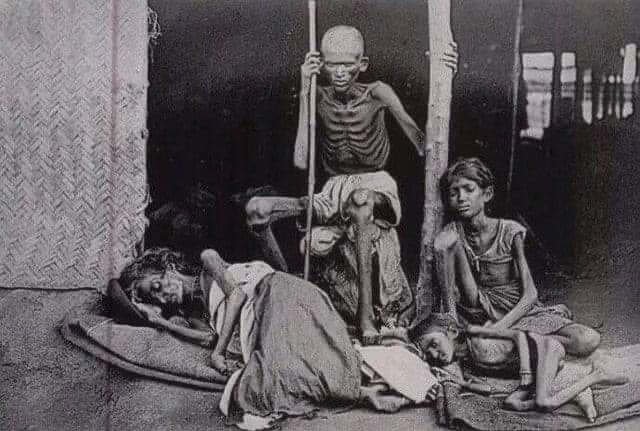
The Great Famine of 1876–78 and the Indian Famine Codes
Tragically, the lessons of Bihar were swiftly abandoned, and officials in London and Calcutta condemned Temple’s relief effort as reckless extravagance. So when the Great Famine of 1876–78 engulfed southern and western India, striking Madras and Bombay together with the princely states of Mysore and Hyderabad before spreading into the Central and North-Western Provinces, the viceroy, Lord Lytton, enforced a strict return to laissez-faire economics. Determined not to repeat Temple’s “excessive” spending, Lytton forbade any government interference in the grain market.
Some 5.5 million people died in British territory alone, and total mortality is estimated at between 6.1 and 10.3 million. Meanwhile, a record 6.4 million hundredweight (320,000 tonnes) of wheat was exported from Indian ports to Britain. In a bitter irony, Temple himself was dispatched as Famine Commissioner to enforce austerity. He cut relief rations to the infamous “Temple wage”: roughly one pound of grain a day in return for gruelling physical labour, which, as Mike Davis notes, provided fewer calories than the diet later recorded at the Buchenwald concentration camp.
In the aftermath, the Famine Commission of 1880 led to the drafting of the Indian Famine Codes. Yet the codes remained preoccupied with preventing “gratuitous” charity, imposing harsh distance and labour tests that deterred the weakest from seeking aid. When twin droughts struck at the close of the century, the relief machinery failed once again.
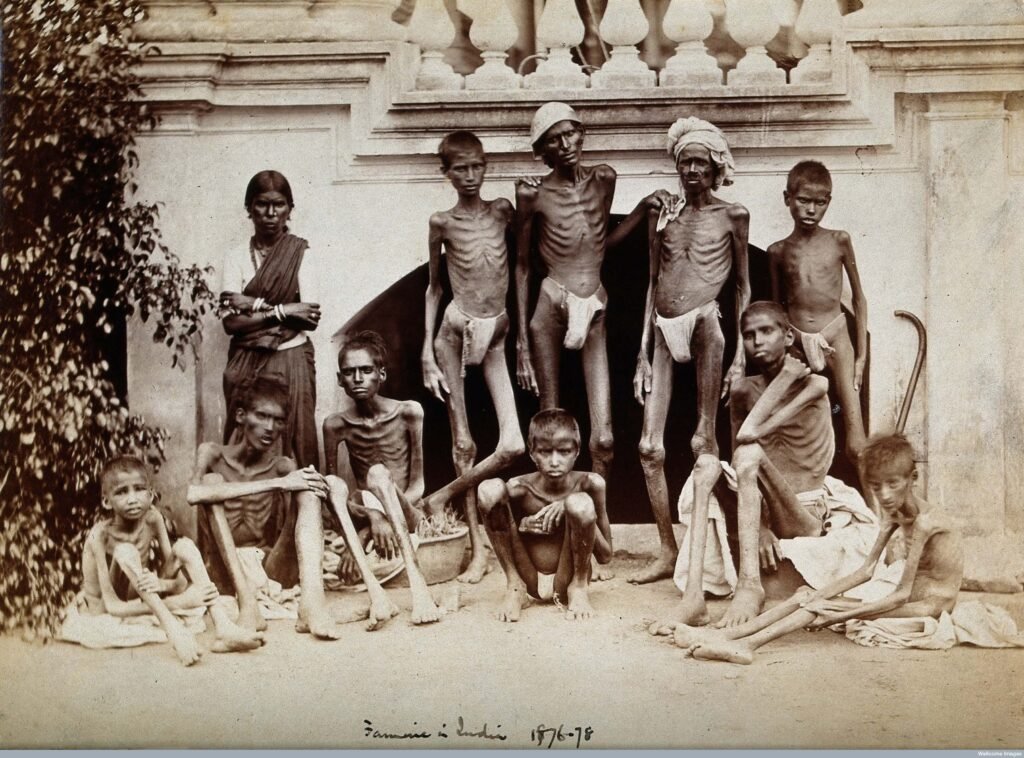
The Indian Famines of 1896–97 and 1899–1900
The Indian Famine of 1896–97 swept across Madras, the Bombay Deccan, Bengal, the United and Central Provinces, Punjab’s Bagar tract, and the princely states of Rajputana and Hyderabad. It claimed roughly five million lives, about one million of them in British territory, while contemporary Western journalists put the toll in British territory alone at 12 to 16 million. Barely two years later, the Indian Famine of 1899–1900 devastated Bombay, the Central Provinces, Berar and Ajmer, along with the princely states of Hyderabad, Rajputana, Central India, Baroda, Kathiawar and Cutch. Between one and 4.5 million people died in British territory alone, and contemporary scholars and economists estimated the toll in British territory at up to ten million. The number of deaths in the princely states remains unknown.
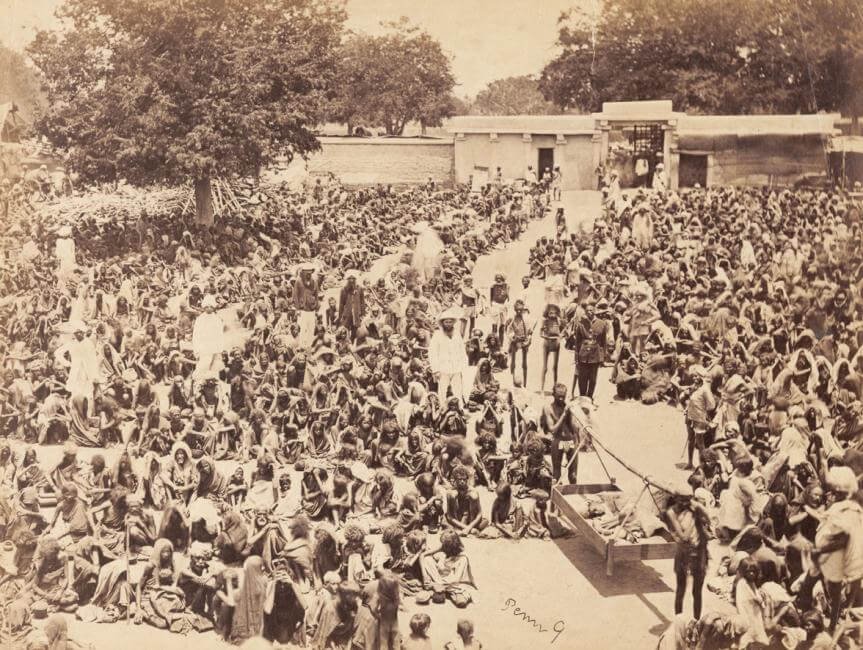
The Bengal Famine of 1943: The Final Catastrophe
By the early twentieth century, better transport links and modest public health reforms had temporarily curbed famine mortality, creating the illusion that the worst of the colonial era had passed. That reprieve collapsed entirely during the Second World War.
In the Bengal Famine of 1943–44, an estimated 1.5 million people died of starvation, and total mortality rose to between 2.1 and 3 million once the waves of malaria and cholera that followed had taken their toll. Crucially, Amartya Sen calculated that the rice harvest in Bengal in 1943 was actually greater than in 1941, a year in which there was no famine.
The Bengal Famine of 1943 was the product of Britain’s wartime policy. Fearing a Japanese invasion through neighbouring Burma, the colonial authorities enacted a “denial policy”, confiscating tens of thousands of boats and surplus rice stocks across coastal Bengal, which instantly paralysed local fishing and the regional grain trade. At the same time, massive deficit spending to finance the war effort triggered runaway inflation. Rice, grown in abundance within Bengal itself, was priced beyond the reach of landless labourers. And despite urgent pleas from officials in India, Winston Churchill’s War Cabinet repeatedly refused to divert Allied shipping to bring emergency grain to Calcutta.
Famines After Independence
The history of famine under British rule leaves little room for ambiguity: mass starvation was not an inevitable consequence of the subcontinent’s climate. It was the result of corporate greed, imperial ambition and the political choices of an administration insulated from the people it governed.
Since 1947, the emerging dominions post-independence (India, Pakistan, and later Bangladesh) have continued to endure failed monsoons and economic hardships. Yet apart from Bangladesh’s famine of 1974, it has not seen famine on anything like the colonial scale, and India or Pakistan have suffered no major famine since independence. That record confirms what the colonial era made plain — that the famines of British India were man-made.
